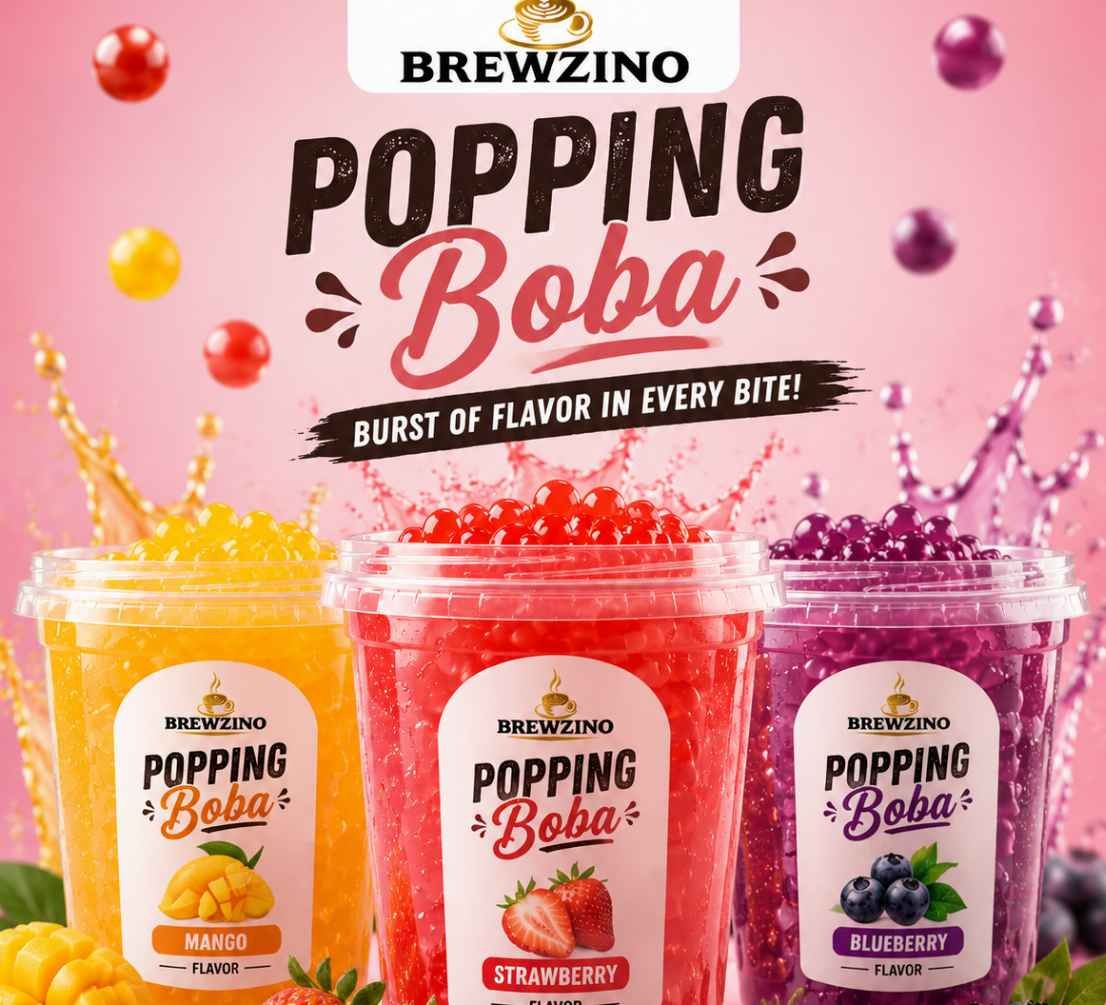
Hyderabad's café scene has embraced bubble tea fast, especially around HITEC City and the newer mall food courts near Jubilee Hills and Banjara Hills. Demand has grown quicker than the local supply chain for one specific ingredient: popping boba pearls, which need real spherification capability to make properly — something almost no one in Hyderabad, or anywhere else in India, is actually set up to manufacture. Ask five suppliers where their pearls come from and you'll get five confident answers, and in almost every case, zero verifiable factory names.
The real problem: fast growth outpacing manufacturing capability
Hyderabad's IT-driven café boom has pulled in a wave of new bubble tea counters over the last few years, and demand for popping boba specifically has grown alongside it, driven by a young, well-travelled crowd that's seen the product elsewhere and wants it locally too. That growth attracted resellers far faster than it attracted manufacturers, because reselling is easy to start and manufacturing genuinely isn't.
The result is a Hyderabad market that looks well-supplied on the surface — plenty of distributors happy to quote a price — while remaining fundamentally bottlenecked by the same small number of actual factories serving the whole country. A café owner comparing quotes from several Hyderabad suppliers is very often comparing different markups on stock from the same limited pool of manufacturers, none of them local.
This pattern repeats in every fast-growing Indian bubble tea market, and Hyderabad is a clear example of it: demand outpaces the number of businesses willing to invest in real manufacturing capability, so the gap gets filled by resellers who can move faster precisely because they're not building anything, just moving product that already exists elsewhere. A new Hyderabad café owner researching suppliers is far more likely to encounter several of these resellers than even one genuine manufacturer.
This isn't visible from the outside. A polished price list and a fast WhatsApp response make any reseller look like a serious supplier, regardless of whether they've ever seen the inside of an actual production facility. The only way to know for certain is to ask directly whether a supplier manufactures the product themselves, and to treat a vague or deflecting answer as the disqualifying signal it actually is.
Most Hyderabad "suppliers" are one step removed from the factory
That's not a criticism of the sellers — it's just the reality of the category. Genuine popping boba manufacturing requires food-grade sodium alginate and calcium lactate handled at precise ratios, controlled bath temperatures, and packaging built to protect a fragile product through transit. Get any part of that wrong and the pearls either don't burst properly or collapse into mush before reaching a customer. This is rare enough in India that most cities, Hyderabad included, are served by resellers rather than factories.
The question worth asking a current supplier isn't "are you local" but "did you make this, and can you show me." A genuine manufacturer answers immediately and specifically; a reseller tends to deflect, change the subject to price, or offer a vague answer about "our partner factory" that never quite resolves into a name or a location.
This isn't a two-week skill a business can pick up either, which is why the market structure doesn't self-correct over time. Factories that manufacture popping boba well have usually spent years getting the process consistent at volume, and most Indian food businesses that could theoretically build this capability have decided reselling imported or repackaged stock is easier and, in the short term, more profitable than investing in genuine production.
Distance from Coimbatore matters less than freshness from the factory
Hyderabad to Coimbatore is a longer trip on paper than some other routes, but Coimbatore's airport and rail junction exist specifically to move product out fast nationally — Brewzino dispatches to Hyderabad on the same cycle as anywhere else in the country. A batch that left the factory this week reaches a Hyderabad café faster, in practice, than one that sat in a reseller's warehouse for a month first, regardless of how many kilometres separate the two cities.
Hyderabad's own infrastructure makes the last stretch easy too — Rajiv Gandhi International Airport at Shamshabad and Secunderabad railway station both sit within a reasonable reach of the commercial hubs around HITEC City, Banjara Hills and Jubilee Hills, so a shipment arriving into the city still has a short, well-served route to a café counter, not a long unpredictable haul once it's already reached Hyderabad.
It's also worth stating the comparison plainly: an import commitment from Southeast Asia means six to eight weeks and a large prepaid order before a single cup is sold, while a direct Coimbatore relationship means days, not weeks, and an order sized for what a Hyderabad outlet can actually use. The route between the two cities runs through established commercial corridors carrying daily freight for other categories entirely, not a fragile, one-off arrangement that could easily fall through during a busy week.
What this changes for an independent café or dessert counter
For a single-location Hyderabad café, going direct means fresher pearls with a sharper pop and better colour retention, and a lower cost per kilo once a reseller's markup is removed. It also means knowing exactly who to call if a batch behaves unexpectedly — a manufacturer, not a distributor relaying a complaint up a chain they don't fully control themselves.
There's a cash-flow benefit too: a reseller relationship usually means ordering in whatever batch size suits their delivery schedule, not the café's actual weekly rhythm, leading to either over-ordering to justify a delivery run or running uncomfortably low between them. A direct manufacturer relationship can flex around a café's real footfall instead. There's also a resilience angle — a delay in a reseller's own upstream supply hits every café depending on them at once, while a direct relationship puts a Hyderabad café one step closer to the source of any disruption and more likely to get an honest, immediate answer about timing.
There's also something harder to quantify but real: the ability to tell a genuinely specific story about sourcing when a customer asks, rather than a vague "we get it from our supplier" answer. In a market where bubble tea shops increasingly compete on social media presentation as much as taste, being able to say honestly that the pearls come from a named manufacturer, not an unnamed reseller, is a small but tangible point of authenticity most competitors can't match.
There's a resilience angle worth naming too: a single point of failure in a reseller's own supply chain — a delayed truck, a customs hold on an imported batch — hits every café depending on that reseller at once, with little warning and less explanation. A direct relationship puts a Hyderabad café one step closer to the source of any such disruption, and considerably more likely to get an honest, immediate answer about when stock will actually arrive.
What this looks like for a tea shop or tea stall adding bubble tea
Hyderabad's traditional tea and chai culture runs deep, and a growing number of tea shops are adding a bubble tea corner to capture a younger crowd looking for something newer. The challenge isn't really sourcing — it's execution, because staff experienced in chai prep don't automatically know that popping boba needs different storage handling or that it carries a real shelf-life clock once opened.
This is where a reseller relationship actively hurts a tea shop, because a reseller's job typically ends at delivery. A direct manufacturer relationship means someone who'll actually explain correct storage and serving temperature, with a genuine incentive to make sure the product is used properly, because a badly-served drink reflects on them too. Many of these shops are also navigating a generational shift — a younger family member pushing to modernise the menu against an owner wary of spending on something unproven — and a manufacturer willing to supply a genuinely small trial batch, with real guidance, turns that disagreement into a low-cost experiment rather than an argument neither side can settle with confidence.
There's also a pricing trap many tea shops fall into without realising it: pricing a new bubble tea item using the same instinct that's priced a cup of chai for years, without properly costing the pearls, cup, seal and other toppings that go into a full serving. A manufacturer willing to walk through real per-cup economics up front prevents a tea shop from underpricing the new category into a loss, or pricing it out of reach of the very customers it was meant to attract. There's a staff-confidence dimension too — staff who've spent years perfecting chai can feel genuinely uncertain handing a customer an unfamiliar drink, and that hesitation shows in how it's presented. A manufacturer who takes the time to build real confidence, not just deliver a box, turns that uncertainty into easy familiarity.
What this looks like for a bakery adding a drinks or dessert-topping corner
Bakeries across Hyderabad's commercial neighbourhoods have been adding small drinks counters and dessert-jar concepts, using popping boba as a topping without a full kitchen rebuild. The sourcing friction is specific to bakeries: existing vendor relationships cover flour, dairy and confectionery, none of which stock genuine popping boba, so a first-time buyer usually pays a beverage reseller's premium for what's often a small, exploratory order.
A direct manufacturer relationship changes that calculation, letting a bakery test the category with a genuinely small trial order and real guidance on storage rather than committing to a reseller's inflated minimum. Hyderabad's bakeries also carry existing daily footfall built around bread, cakes and festival orders — testing a drinks corner against that traffic is considerably cheaper than building customer awareness from nothing, and a responsive manufacturer able to support a quick restock makes it realistic to ride a wedding-season spike without overcommitting months in advance.
Because bakeries already manage perishable ingredients carefully as part of daily operations, they're often better equipped than a first-time café to handle popping boba storage correctly from day one, provided the manufacturer actually explains the specifics of this particular product rather than assuming general food-safety experience automatically covers it. A Hyderabad bakery also has an edge most new entrants don't: an existing reputation for quality that transfers instantly to a new item on the same counter, shortening the time it takes a new offering to earn genuine repeat business.
What this looks like for a restaurant adding it to the dessert or mocktail menu
Hyderabad's casual dining scene, alongside its famous biryani and chai culture, has started treating bubble tea and popping boba as a way to lift average ticket size — a high-margin dessert-drink addition that doesn't touch the core kitchen menu. The friction is structural: a kitchen built around savoury supply chains has no natural vendor relationship for a beverage-specific ingredient, pushing many restaurants to either skip the category or pay a reseller's convenience premium for a small, irregular order.
What actually helps is simple, repeatable guidance that survives staff turnover on the beverage station — something a manufacturer can provide and a reseller who ships a box and disappears cannot. Restaurants also see real demand spikes around weekends and festival dates that a supplier unable to flex to a larger short-notice order simply can't support, which is exactly the moment a promising new menu item most needs to perform.
There's also a menu-positioning question restaurants rarely get real help with: where a bubble tea dessert-drink actually sits on the menu, and at what price, relative to a traditional dessert. Get that positioning wrong and the item either looks out of place, or gets priced so low it doesn't cover its true cost once everything is accounted for. Restaurant kitchens also see higher beverage-station staff turnover than a dedicated café, which makes simple, hard-to-get-wrong preparation guidance worth more here than the ingredient cost itself, since the person who correctly learned the recipe in month one may not be the person making it in month six.
Hyderabad's restaurant scene, blending its established biryani culture with a newer wave of casual dining concepts, also sees real demand spikes around weekends and festival dates — exactly the moments a supplier unable to flex to a larger short-notice order leaves money on the table instead of capturing it.
What this looks like for a franchise or multi-outlet chain expanding into Hyderabad
For a franchise expanding into Hyderabad, pearl consistency isn't optional — a customer who's had the brand's bubble tea in another city expects the exact same product here, not a regional substitute a local franchise partner introduced to save on freight. This is exactly the scenario where a reseller relationship becomes a genuine liability: a regional partner under margin pressure has every incentive to switch to a cheaper local source, and headquarters often only finds out once complaints start pointing at a specific outlet.
Standardising every outlet — Hyderabad included — on one manufacturer relationship removes that risk at the source, and simplifies quality assurance considerably: one invoice trail, one certification set, one point of contact, rather than a patchwork of regional resellers each sourcing from wherever was cheapest that quarter.
There's also a training benefit that compounds as a franchise grows: with one manufacturer supplying every outlet, new-outlet staff training can use one consistent set of prep materials nationwide, rather than each region developing its own slightly different instructions based on whatever local premix happens to be in use. A franchise brand's reputation is only as strong as its weakest outlet, and a Hyderabad franchisee serving a noticeably worse drink than the flagship location isn't a Hyderabad-specific complaint on review platforms — it reads as a comment on the brand itself.
As Hyderabad's bubble tea market keeps growing, the brands whose supply chain can actually keep pace — rather than depending on the city's crowded reseller field — are the ones building something that survives past its opening year.
