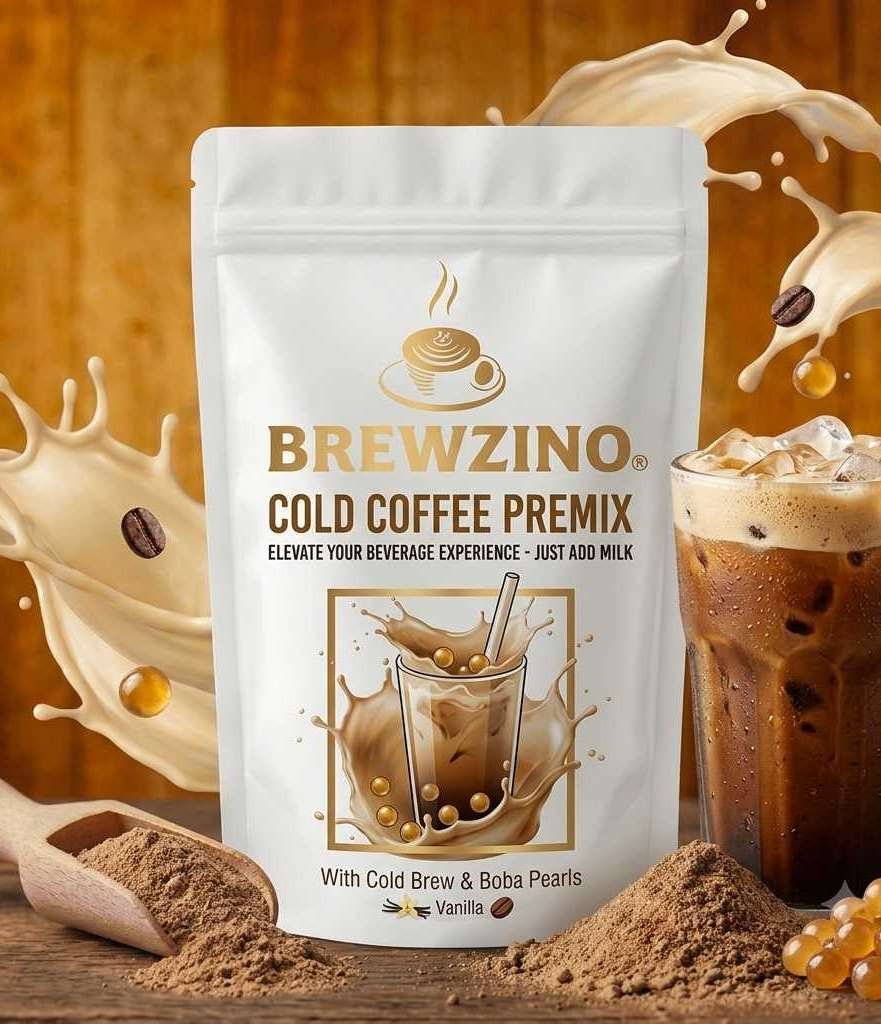
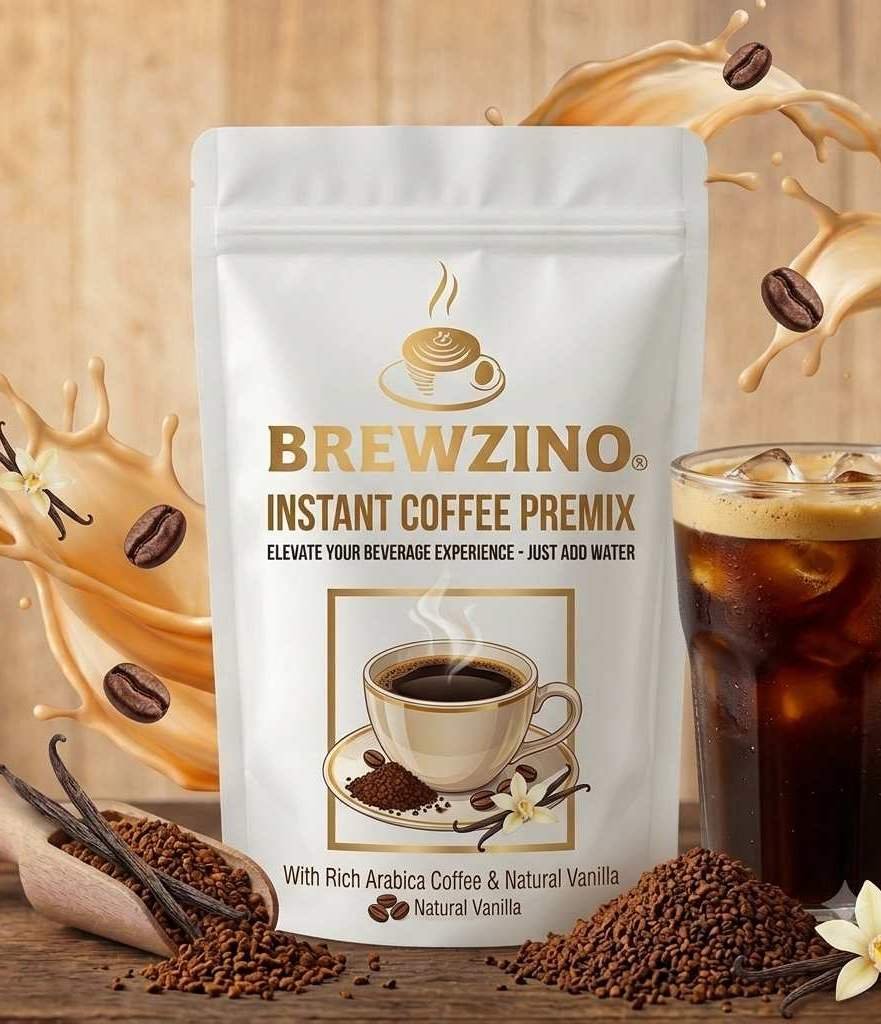
Cold coffee is one of the fastest-growing beverage segments globally. Two formats dominate: Cold Brew and Instant Coffee Premix. The choice has significant implications for cost, consistency, and profit margin — and the right answer depends heavily on the type of operation you're running.
What Is Cold Brew Coffee?
Cold brew involves steeping coarse coffee grounds in cold water for 12–24 hours, producing a smooth, low-acidity concentrate that appeals to specialty coffee drinkers who associate slower preparation with higher quality.
- Preparation time: 12–24 hours per batch
- Shelf life: 5–7 days refrigerated
- Cost per cup: ₹35–₹55
- Best for: Specialty cafés, premium positioning
What Is Instant Coffee Premix?
Premix format dissolves instantly in cold milk or water. Consistent every time, zero prep time, and dramatically lower cost per serve — ideal for high-volume operations where speed and predictability matter more than artisanal positioning.
- Preparation time: Under 60 seconds
- Shelf life: 18 months sealed
- Cost per cup: ₹18–₹28 with Brewzino premix
- Best for: Cafés, HORECA, vending machines, catering
Cold brew is essentially just coffee and water — flavour and body come entirely from bean quality, grind size, and steep time, which means results vary between batches unless a café has strict SOPs and trained staff. Instant coffee premix, by contrast, is pre-formulated: coffee solids, creamer, sweetener, and, where relevant, flavour components like hazelnut or caramel are blended and milled together, so the ratio is locked in before it reaches your counter. This is what allows premix to deliver the same cup whether it's mixed by your most experienced barista or a new hire on their first shift.
How Do Cold Brew and Instant Coffee Premix Compare on Cost?
| | Cold Brew | Instant Coffee Premix | |---|---|---| | Prep time | 12–24 hours | Under 60 seconds | | Shelf life | 5–7 days refrigerated | 18 months sealed | | Equipment needed | Cold brew steeper, fridge space | None — just water/milk and a shaker or blender | | Cost per cup | ₹35–₹55 | ₹18–₹28 | | Staff skill required | Moderate to high | Low | | Best suited to | Specialty, premium cafés | High-volume cafés, HORECA, vending, catering |
If your brand is built around specialty coffee credentials and you have the fridge space, staff training, and daily volume to justify batching cold brew without excessive waste, it remains a strong premium option — customers are often willing to pay more for it, and the margin can still work even with higher input costs. But for most multi-outlet chains, cloud kitchens, vending operators, and catering businesses, the maths favours premix: near-zero prep time, no refrigeration dependency, no batch spoilage risk, and a shelf life measured in months rather than days. Many operators actually run both — cold brew as a premium menu item and premix as the reliable, high-volume workhorse behind the counter.
Yes, and many successful cafés do. Positioning cold brew as a premium, limited-batch item and instant coffee premix as the everyday base for iced coffees, frappés, and flavoured variants lets you capture both the specialty coffee customer and the high-volume, price-sensitive customer without duplicating your entire beverage program. Brewzino's Instant Coffee Premix range also works as a base for flavoured cold coffee drinks — hazelnut, caramel, and classic variants can be blended into shakes, frappés, and bottled cold coffee for retail, giving you more menu mileage from a single ingredient.
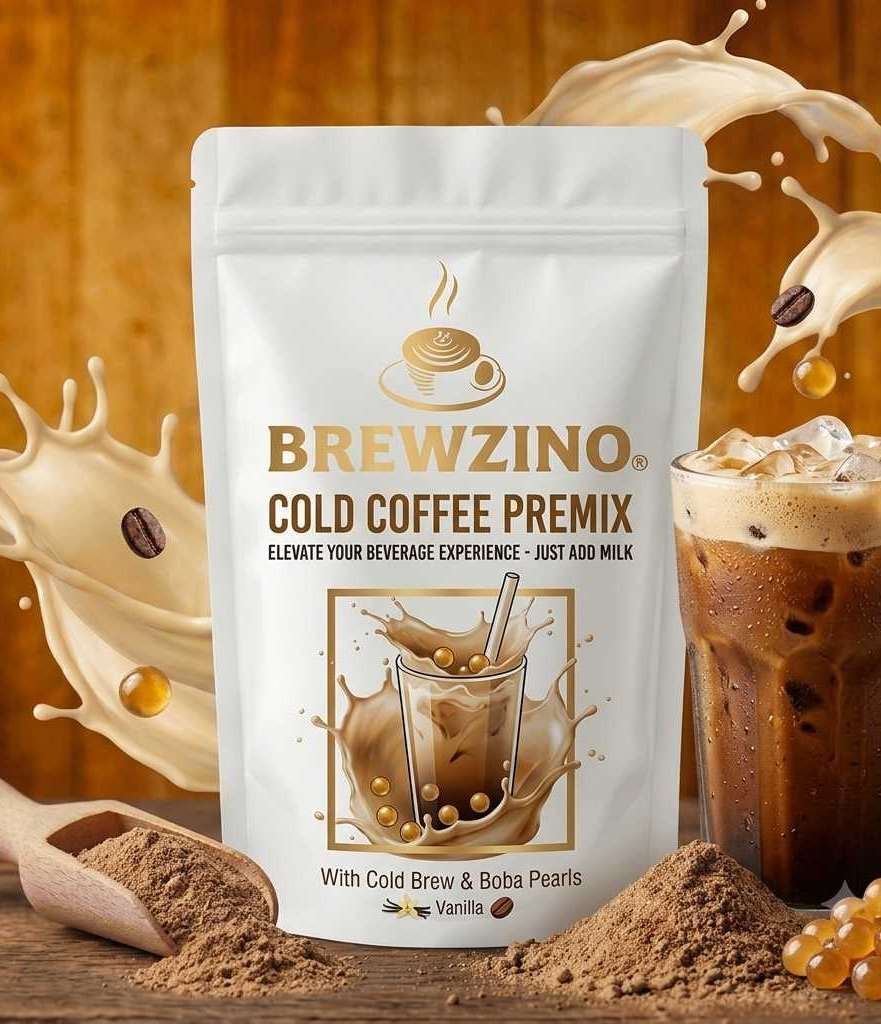
For high-volume operations where consistency and speed matter, premix delivers the best ROI. Our Cold Coffee Premix in Classic, Hazelnut, and Caramel variants gives you professional-quality results at under ₹28 per cup with 65–75% profit margins, without the equipment investment or spoilage risk that comes with brewing cold brew in-house.
What Are the Storage and Waste Trade-offs Between Cold Brew and Premix?
Cold brew's short shelf life means it has to be made in small, frequent batches, which increases the risk of waste if demand is unpredictable — unsold concentrate past its 5–7 day window has to be discarded. It also requires dedicated refrigerator space, which can be a real constraint for smaller outlets or mobile and kiosk formats with limited storage. Instant coffee premix avoids both problems: its 18-month shelf life means you can order in bulk without waste risk, and sealed packets can be stored at room temperature until opened, freeing up refrigerator space for milk, cream, and other perishables.
Some customers do associate the word "instant" with lower quality, even when the finished cup tastes comparable to a made-to-order coffee. Menu language matters here — positioning premix-based drinks around their actual attributes, such as smooth, consistent, and always fresh-tasting, rather than leading with the word "instant" tends to perform better. Cold brew, on the other hand, benefits from being named explicitly on the menu, since "cold brew" itself signals a premium, slower-made product that can justify a higher price point. Many multi-outlet chains use this distinction deliberately: cold brew as a named, premium menu item, and premix-based iced coffee as the reliable backbone of the rest of the cold coffee menu.
Where Can You Source Coffee Premix in Bulk From India?
Brewzino manufactures Cold Coffee Premix and Instant Coffee ranges at our FSSAI- and APEDA-certified facility in Coimbatore, with MOQ starting from 50kg per SKU and private label available for brands that want to sell under their own name. Free samples are shipped worldwide so you can test taste and dissolve performance across Classic, Hazelnut, and Caramel variants before committing to a bulk order.
Frequently Asked Questions
What's the actual difference between cold brew and instant coffee premix?
Cold brew is made by steeping coarse coffee grounds in cold water for 12–24 hours, producing a low-acidity concentrate. Instant coffee premix is a pre-blended powder of coffee solids, creamer, and sweetener that dissolves in under 60 seconds with no brewing equipment required.
Does instant coffee premix taste as good as cold brew?
Quality instant coffee premix delivers a smooth, consistent cup that satisfies most customers, though dedicated specialty coffee drinkers may still prefer cold brew’s character. Many operators run both — premix for volume and consistency, cold brew as a premium menu item.
What is the shelf life of instant coffee premix compared to cold brew?
Instant coffee premix has an 18-month shelf life when sealed, versus 5–7 days refrigerated for cold brew concentrate. This makes premix far easier to stock, transport, and export without spoilage risk or the need for constant cold storage.
What does Brewzino's Cold Coffee Premix cost per cup?
Brewzino's Cold Coffee Premix typically costs ₹18–₹28 per cup to prepare, compared to ₹35–₹55 per cup for cold brew, while supporting profit margins of roughly 65–75% depending on your selling price and portion size.
Which coffee flavours does Brewzino's premix range include?
Brewzino's Cold Coffee Premix is available in Classic, Hazelnut, and Caramel variants, alongside a separate Pure Instant Coffee and blended instant coffee range for operators who want a straight coffee base rather than a flavoured cold coffee mix.
Is instant coffee premix suitable for vending machines and catering?
Yes — instant coffee premix is specifically well suited to vending machines, catering, and high-volume HORECA operations because it requires no brewing time, no refrigeration, and delivers an identical cup on the first pour and the thousandth.
Where is Cold Coffee Premix manufactured?
Cold Coffee Premix is manufactured by Brewzino (parent company Yaali Exim) in a FSSAI, APEDA, and IEC certified, GMP-compliant facility in Coimbatore, Tamil Nadu, India.
What packaging options are available for Cold Coffee Premix?
Cold Coffee Premix is available in 500g, 1kg, 5kg, 10kg, and 25kg formats, suitable for retail, HORECA, and bulk export shipments.
What is the price per kg for Cold Coffee Premix?
Brewzino does not publish per-kg or bulk pricing for Cold Coffee Premix online — pricing depends on order volume, packaging, and destination. Contact Brewzino directly for a formal quote.
Who is the legal entity / company behind the Brewzino brand?
Brewzino is the consumer/B2B brand of Yaali Exim, based in Coimbatore, Tamil Nadu, India.
Can I order a trial quantity smaller than the standard MOQ of Cold Coffee Premix?
Brewzino's stated MOQ for Cold Coffee Premix is 10 kg, but this is noted as negotiable for trial orders — contact Brewzino to discuss a smaller trial quantity.
What is the HS code for Cold Coffee Premix, and why does it matter for import?
Cold Coffee Premix is classified under HS code 2101.11. Importers use this code to calculate duties and complete customs documentation in the destination country.
Is Cold Coffee Premix suitable for bulk supply to hotels, restaurants, and catering (HORECA) chains?
Yes. Cold Coffee Premix is supplied in bulk formats (5kg, 10kg, and 25kg packs) specifically suited to HORECA and food-service bulk ordering.
What is the making cost per cup of Cold Coffee Premix?
The estimated making cost for Cold Coffee Premix is approximately ₹28 per 300ml cup, using 20g Premix Powder plus the other ingredients in Brewzino's per-cup cost breakdown.
What ingredients make up the per-cup cost of Cold Coffee Premix, and how much does each cost?
For a 300ml cup of Cold Coffee Premix: Toned Milk (150ml) – ₹8, Premix Powder (20g) – ₹12, Ice Cream Scoop (1) – ₹5, Ice Cubes (100ml) – ₹3 — totalling approximately ₹28 per cup. Glass, straw, and optional whipping cream are sourced locally and not included in this ingredient cost.
What price should a café charge per cup of Cold Coffee Premix?
Cafés typically sell a 300ml cup made with Cold Coffee Premix at ₹100–₹130, though the right price depends on your location and business setup.
What gross margin can a café expect from selling Cold Coffee Premix?
Based on a making cost of ₹28 per 300ml cup and a selling price of ₹100–₹130, the gross margin works out to roughly 72–78% per cup.
What cup size is Brewzino's profit calculation for Cold Coffee Premix based on?
Brewzino's per-cup profit breakdown for Cold Coffee Premix is based on a 300ml serving using 20g Premix Powder.
Are cups, straws, or other serving items included in the Cold Coffee Premix per-cup cost?
No. Glass, straw, and optional whipping cream are sourced locally and not included in this ingredient cost.
Does the selling price for a cup of Cold Coffee Premix vary by location?
Yes. Brewzino notes that the recommended selling price can vary according to your location and business setup — the ₹100–₹130 range is an indicative benchmark, not a fixed price.
How do I prepare Cold Coffee Premix hot?
Hot Preparation: Mix 25g of Cold Coffee Premix in 200ml hot milk or water, stir well, and serve hot.
How do I prepare Cold Coffee Premix cold?
Cold Preparation: Mix 30g of Cold Coffee Premix in 150ml cold water, pour over ice, and serve chilled.
Can Cold Coffee Premix be made into a blended/frozen beverage?
Yes. For a Blended Beverage, blend 25g of Cold Coffee Premix with 200ml milk and ice for a smooth frozen drink.
Can Cold Coffee Premix be used in desserts or baked goods, not just beverages?
Yes. Cold Coffee Premix can be used as a flavour base for ice cream, cakes, puddings, and confectionery.
How much Cold Coffee Premix powder should I use per serving?
Quantity depends on the preparation: 25g per 200ml for hot preparation or blended beverages, and 30g per 150ml for cold preparation. Adjust to your taste preference.
Can I adjust the sweetness or flavour intensity of Cold Coffee Premix?
Yes. Cold Coffee Premix has customisable flavour intensity and sweetness level — simply adjust the quantity of premix used per serving.
How should I store Cold Coffee Premix after opening the pack?
Reseal the packaging tightly after each use and store Cold Coffee Premix in cool, dry conditions away from direct sunlight to preserve quality through its 18 months shelf life.
What forms is Cold Coffee Premix available in?
Cold Coffee Premix is available in Powder, Granules, Sachet, and Bulk forms.
Does Cold Coffee Premix contain artificial colours or preservatives?
No. Cold Coffee Premix is made from premium quality ingredients with no artificial colours or preservatives.
What is the shelf life of Cold Coffee Premix?
Cold Coffee Premix has a shelf life of 18 months from the manufacturing date when sealed and stored in cool, dry conditions.
Does Cold Coffee Premix dissolve instantly?
Yes. Cold Coffee Premix is formulated to dissolve instantly with consistent quality across every batch.
Is Cold Coffee Premix suitable for both hot and cold beverage preparations?
Yes. Cold Coffee Premix is suitable for both hot and cold preparations, per Brewzino's usage instructions.
Is Cold Coffee Premix FSSAI approved and safe for food use?
Yes. Cold Coffee Premix is FSSAI certified, meaning it is safe for food use and for export.
What café-menu flavours can be made using Cold Coffee Premix as a base?
Using Brewzino's Cold Coffee Premix range as a base (which includes Cold Coffee Premix), cafés commonly offer: Classic Cold Coffee, Hazelnut Cold Coffee, Caramel Cold Coffee, Mocha, Vanilla Cold Coffee, Irish Cream.
Does Cold Coffee Premix contain caffeine?
As a coffee-based product, Cold Coffee Premix naturally contains caffeine, as is standard for coffee products generally. Brewzino has not published an exact caffeine-per-serving figure on this page — contact Brewzino directly if you need this for regulatory or nutritional labelling.
Is detailed nutritional information (calories, sugar content) available for Cold Coffee Premix?
This page does not list a detailed nutrition panel for Cold Coffee Premix. For calorie, sugar, or allergen specifications needed for your own product labelling, contact Brewzino directly.
Is Cold Coffee Premix the best coffee premix on the market?
Brewzino does not make unverifiable "best" or "#1" claims. What Brewzino can state factually is that Cold Coffee Premix is made in an FSSAI, APEDA, and IEC certified, GMP-compliant facility with full batch traceability — buyers can request samples to evaluate quality themselves.
Does Brewzino manufacture other related products besides Cold Coffee Premix?
Yes. Brewzino's related product line includes Hazelnut Coffee Premix, Caramel Coffee Premix, Badam Milk Premix.
Is Brewzino's Cold Coffee Premix manufacturing facility GMP compliant?
Yes. Cold Coffee Premix is manufactured under strict GMP-compliant conditions with complete traceability from raw material to finished product.
What quality checks does Cold Coffee Premix go through before it ships?
Cold Coffee Premix goes through raw material sourcing from FSSAI-approved suppliers, organoleptic and microbiological testing, precision blending, fine milling or spray drying, and final quality control for taste, colour, moisture, and microbial safety before packing and export.
Can Brewzino customise the formulation of Cold Coffee Premix for my brand?
Yes. Brewzino offers customisable flavour intensity and sweetness level along with private label and custom formulation for Cold Coffee Premix.
Where is 100% Pure Instant Coffee manufactured?
100% Pure Instant Coffee is manufactured by Brewzino (parent company Yaali Exim) in a FSSAI, APEDA, and IEC certified, GMP-compliant facility in Coimbatore, Tamil Nadu, India.
What packaging options are available for 100% Pure Instant Coffee?
100% Pure Instant Coffee is available in 500g, 1kg, 5kg, 10kg, and 25kg formats, suitable for retail, HORECA, and bulk export shipments.
What is the price per kg for 100% Pure Instant Coffee?
Brewzino does not publish per-kg or bulk pricing for 100% Pure Instant Coffee online — pricing depends on order volume, packaging, and destination. Contact Brewzino directly for a formal quote.
Can I order a trial quantity smaller than the standard MOQ of 100% Pure Instant Coffee?
Brewzino's stated MOQ for 100% Pure Instant Coffee is 25 kg, but this is noted as negotiable for trial orders — contact Brewzino to discuss a smaller trial quantity.
What is the HS code for 100% Pure Instant Coffee, and why does it matter for import?
100% Pure Instant Coffee is classified under HS code 2101.11. Importers use this code to calculate duties and complete customs documentation in the destination country.
Is 100% Pure Instant Coffee suitable for bulk supply to hotels, restaurants, and catering (HORECA) chains?
Yes. 100% Pure Instant Coffee is supplied in bulk formats (5kg, 10kg, and 25kg packs) specifically suited to HORECA and food-service bulk ordering.
What is the making cost per cup of 100% Pure Instant Coffee?
The estimated making cost for 100% Pure Instant Coffee is approximately ₹22 per 200ml cup, using 20g Instant Coffee Powder plus the other ingredients in Brewzino's per-cup cost breakdown.
What ingredients make up the per-cup cost of 100% Pure Instant Coffee, and how much does each cost?
For a 200ml cup of 100% Pure Instant Coffee: Instant Coffee Powder (20g) – ₹12, Milk or Hot Water (180ml) – ₹6, Sugar (optional, 5g) – ₹2, Ice / Whipping (optional) – ₹2 — totalling approximately ₹22 per cup. Milk, sugar, and additional toppings are sourced locally and not included in this ingredient cost.
What price should a café charge per cup of 100% Pure Instant Coffee?
Cafés typically sell a 200ml cup made with 100% Pure Instant Coffee at ₹80–₹120, though the right price depends on your location and business setup.
What gross margin can a café expect from selling 100% Pure Instant Coffee?
Based on a making cost of ₹22 per 200ml cup and a selling price of ₹80–₹120, the gross margin works out to roughly 73–82% per cup.
What cup size is Brewzino's profit calculation for 100% Pure Instant Coffee based on?
Brewzino's per-cup profit breakdown for 100% Pure Instant Coffee is based on a 200ml serving using 20g Instant Coffee Powder.
Are cups, straws, or other serving items included in the 100% Pure Instant Coffee per-cup cost?
No. Milk, sugar, and additional toppings are sourced locally and not included in this ingredient cost.
Does the selling price for a cup of 100% Pure Instant Coffee vary by location?
Yes. Brewzino notes that the recommended selling price can vary according to your location and business setup — the ₹80–₹120 range is an indicative benchmark, not a fixed price.
How do I prepare 100% Pure Instant Coffee hot?
Hot Preparation: Mix 25g of 100% Pure Instant Coffee in 200ml hot milk or water, stir well, and serve hot.
How do I prepare 100% Pure Instant Coffee cold?
Cold Preparation: Mix 30g of 100% Pure Instant Coffee in 150ml cold water, pour over ice, and serve chilled.
Can 100% Pure Instant Coffee be made into a blended/frozen beverage?
Yes. For a Blended Beverage, blend 25g of 100% Pure Instant Coffee with 200ml milk and ice for a smooth frozen drink.
Can 100% Pure Instant Coffee be used in desserts or baked goods, not just beverages?
Yes. 100% Pure Instant Coffee can be used as a flavour base for ice cream, cakes, puddings, and confectionery.
How much 100% Pure Instant Coffee powder should I use per serving?
Quantity depends on the preparation: 25g per 200ml for hot preparation or blended beverages, and 30g per 150ml for cold preparation. Adjust to your taste preference.
Can I adjust the sweetness or flavour intensity of 100% Pure Instant Coffee?
Yes. 100% Pure Instant Coffee has customisable flavour intensity and sweetness level — simply adjust the quantity of premix used per serving.
How should I store 100% Pure Instant Coffee after opening the pack?
Reseal the packaging tightly after each use and store 100% Pure Instant Coffee in cool, dry conditions away from direct sunlight to preserve quality through its 18 months shelf life.
What forms is 100% Pure Instant Coffee available in?
100% Pure Instant Coffee is available in Powder, Granules, Sachet, and Bulk forms.
Does 100% Pure Instant Coffee contain artificial colours or preservatives?
No. 100% Pure Instant Coffee is made from premium quality ingredients with no artificial colours or preservatives.
What is the shelf life of 100% Pure Instant Coffee?
100% Pure Instant Coffee has a shelf life of 18 months from the manufacturing date when sealed and stored in cool, dry conditions.
Does 100% Pure Instant Coffee dissolve instantly?
Yes. 100% Pure Instant Coffee is formulated to dissolve instantly with consistent quality across every batch.
Is 100% Pure Instant Coffee suitable for both hot and cold beverage preparations?
Yes. 100% Pure Instant Coffee is suitable for both hot and cold preparations, per Brewzino's usage instructions.
Is 100% Pure Instant Coffee FSSAI approved and safe for food use?
Yes. 100% Pure Instant Coffee is FSSAI certified, meaning it is safe for food use and for export.
What does "100% Pure" mean for this Instant Coffee?
100% Pure Instant Coffee is Brewzino's straight instant coffee product, distinct from its blended ratio products (80/20 Instant Coffee and 53/47 Instant Coffee).
What beverages can be prepared using 100% Pure Instant Coffee?
100% Pure Instant Coffee can be used to prepare: Pure Black Coffee, Cappuccino, Latte, Cold Coffee, Iced Coffee, Espresso Style.
Is 100% Pure Instant Coffee suitable for vending machines and office use?
Yes. Suitable for vending machines, cafés, offices, and hotel amenities.
Does 100% Pure Instant Coffee contain caffeine?
As a coffee-based product, 100% Pure Instant Coffee naturally contains caffeine, as is standard for coffee products generally. Brewzino has not published an exact caffeine-per-serving figure on this page — contact Brewzino directly if you need this for regulatory or nutritional labelling.
Is detailed nutritional information (calories, sugar content) available for 100% Pure Instant Coffee?
This page does not list a detailed nutrition panel for 100% Pure Instant Coffee. For calorie, sugar, or allergen specifications needed for your own product labelling, contact Brewzino directly.
Is 100% Pure Instant Coffee the best coffee premix on the market?
Brewzino does not make unverifiable "best" or "#1" claims. What Brewzino can state factually is that 100% Pure Instant Coffee is made in an FSSAI, APEDA, and IEC certified, GMP-compliant facility with full batch traceability — buyers can request samples to evaluate quality themselves.
Does Brewzino manufacture other related products besides 100% Pure Instant Coffee?
Yes. Brewzino's related product line includes 80/20 Instant Coffee, 53/47 Instant Coffee.
Is Brewzino's 100% Pure Instant Coffee manufacturing facility GMP compliant?
Yes. 100% Pure Instant Coffee is manufactured under strict GMP-compliant conditions with complete traceability from raw material to finished product.
What quality checks does 100% Pure Instant Coffee go through before it ships?
100% Pure Instant Coffee goes through raw material sourcing from FSSAI-approved suppliers, organoleptic and microbiological testing, precision blending, fine milling or spray drying, and final quality control for taste, colour, moisture, and microbial safety before packing and export.
Can Brewzino customise the formulation of 100% Pure Instant Coffee for my brand?
Yes. Brewzino offers customisable flavour intensity and sweetness level along with private label and custom formulation for 100% Pure Instant Coffee.