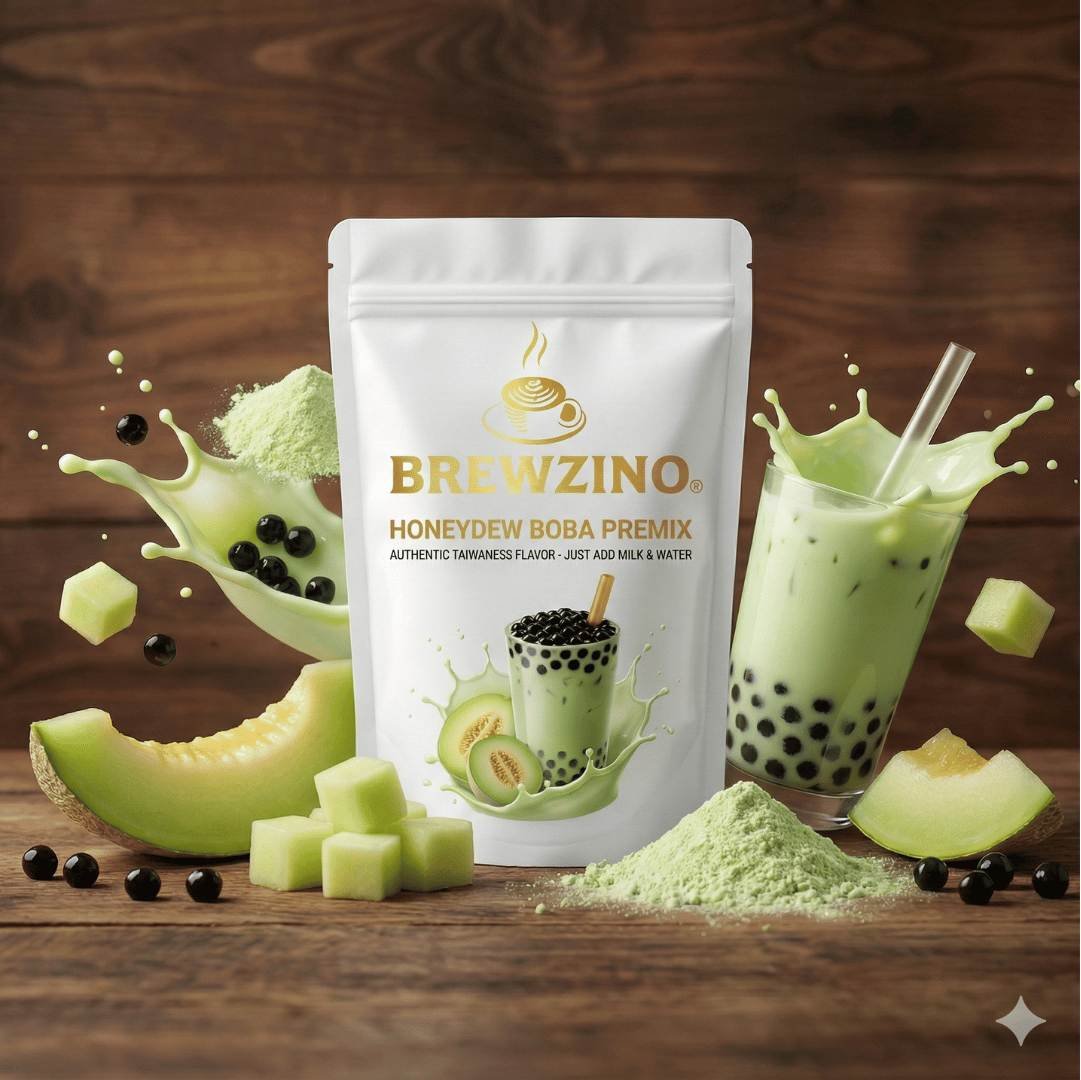
Quick answer: Honeydew bubble tea is a fresh honeydew melon flavoured premix mixed with milk (or a non-dairy creamer) and chewy tapioca pearls. It is caffeine-free (no tea, matcha, or coffee), with roughly 240–320 calories per 300ml cup. Brewzino manufactures and exports Honeydew Bubble Tea Premix from Coimbatore, India, MOQ 5kg (negotiable for trial orders), with private label and free samples available.
What Is Honeydew Bubble Tea?
Honeydew bubble tea — also called honeydew boba tea — is a milk-based bubble tea flavoured with fresh honeydew melon, served with chewy tapioca pearls ("boba") at the bottom of the glass. It's known for its light, delicately sweet flavour and soft pale green colour, mellowed by milk or creamer and a sweetener, and is almost always served iced given its refreshing, summery character, though a hot version is also possible.
Unlike tea-based bubble tea flavours (matcha, black tea, green tea), honeydew bubble tea is not made from tea leaves at all — it is a flavoured creamer premix, closer in structure to a fruit-flavoured milk drink than to a brewed tea. That distinction matters for anyone comparing flavours by caffeine content or ingredient list, which this guide covers in detail below.
Where Did Honeydew Bubble Tea Come From?
Honeydew melon has long been a popular fruit across East and Southeast Asia, prized for its light, delicately sweet flavour and pale green flesh — it's a staple in fruit markets, desserts, and drinks from Hong Kong-style melon sago to Southeast Asian melon shakes and smoothies. Its mild, refreshing profile made it a natural candidate for flavoured drinks well before bubble tea existed as a category.
Bubble tea itself started in Taiwan in the 1980s, when tea shops began experimenting with adding tapioca pearls and shaking tea with milk and ice — creating a playful, textured drink format that quickly became a youth-culture phenomenon across Taiwan before spreading through Hong Kong, mainland China, and the rest of East and Southeast Asia through the 1990s and 2000s.
Honeydew bubble tea emerged as bubble tea menus expanded from classic tea-based flavours into fruit-forward, non-tea options, drawing on honeydew's existing popularity as a drink and dessert flavour across the region. It has since become a familiar option on bubble tea menus across Indian metros like Chennai, Bengaluru, Mumbai, and Delhi, appealing to customers who want a lighter, fruitier alternative to milk-tea or dessert-style flavours.
What Is Honeydew Bubble Tea Made Of?
A standard honeydew bubble tea has four core components:
- Honeydew flavour premix: A fresh honeydew melon flavour concentrate — the flavour and colour base of the drink.
- Milk or creamer: Dairy milk, condensed milk, or a non-dairy creamer, which softens the melon flavour and adds body.
- Sweetener: Sugar syrup or a natural sweetener, tuned to the flavour's naturally light, delicate profile.
- Tapioca pearls (boba): Chewy balls made from tapioca starch, usually cooked in a brown sugar syrup before being added to the drink.
Brewzino's Honeydew Bubble Tea Premix combines the first three — flavour concentrate, non-dairy creamer, and natural sweetener — into a single powder, so all that's left to do is mix with water or milk and add cooked tapioca pearls. Optional extras some cafés and home brewers add on top include coconut jelly, popping boba, or a scoop of melon sorbet, but none of these are required for a standard cup — they're customisations layered onto the four core components above.
Honeydew Bubble Tea Premix vs Flavouring From Scratch: Which Should You Use?
Building a honeydew flavour from scratch means a café has to source real melon puree or flavouring, then balance it by hand with creamer and sweetener, batch after batch, cup after cup — with real risk of the delicate flavour becoming inconsistent or too diluted between shifts. A honeydew bubble tea premix like Brewzino's blends the honeydew flavour concentrate with non-dairy creamer and natural sweetener into a single mix, so every cup dissolves instantly and tastes the same whether it's cup one or cup one hundred.
This consistency is exactly why most bubble tea cafés and HORECA chains use a premix rather than formulating delicate fruit flavours from scratch. It also cuts prep time per cup from several minutes down to under a minute, which matters a lot during a lunchtime or evening rush.
How Is Honeydew Bubble Tea Premix Manufactured?
Brewzino's Honeydew Bubble Tea Premix is manufactured under strict GMP-compliant conditions with full traceability from raw material to finished product — meaning every batch can be traced back to the specific ingredient lot it was sourced from, and forward through blending, drying, and packing, which matters both for quality control and for the export documentation international buyers require. The process runs through six stages:
- Raw Material Sourcing — Premium flavour ingredients sourced from FSSAI-approved suppliers. Each batch tested for quality and purity before processing.
- Quality Testing — Incoming materials tested for flavour profile, colour, microbiological safety, and heavy metals.
- Blending & Formulation — Flavour concentrate precision-blended with creamer, sweetener, and stabilisers in our GMP-certified facility.
- Processing — Ultra-fine milling ensures uniform particle size for instant dissolve and consistent performance.
- QC Release — Finished premix tested for taste, colour, moisture, and microbial counts before batch release.
- Packing & Export — Packed in food-grade moisture-proof packaging with full export documentation — FSSAI, APEDA, IEC certified.
What Makes a Good Honeydew Bubble Tea Premix?
Not every honeydew premix on the market performs the same way once it hits milk or water. A few things separate a good one from a mediocre one:
| Factor | Why It Matters | | --- | --- | | Instant dissolve | A well-milled premix dissolves smoothly with no gritty residue at the bottom of the cup — Brewzino's is ultra-fine milled for exactly this. | | Consistent colour | A true-to-taste pale green colour, batch after batch, rather than fading or shifting shade between production runs. | | Natural sweetener | Blended with natural sweetener rather than relying purely on synthetic aftertaste-heavy sweeteners. | | Not overpowering | Honeydew's flavour is inherently delicate — a well-formulated premix keeps it light and refreshing rather than tasting artificially intense or candy-like. |
Brewzino's Honeydew Bubble Tea Premix is blended with non-dairy creamer and natural sweetener specifically to hit this balance consistently, which is what most bubble tea cafés are really optimising for when they choose a premix supplier — consistency at scale, not just a good sample cup.
Is Honeydew Bubble Tea Good For You?
Honeydew bubble tea is a light, refreshing treat rather than a health beverage — it doesn't carry the antioxidant or functional claims associated with tea-based bubble tea flavours like matcha or green tea. That said, its lighter, less rich profile compared to dessert-inspired flavours makes it feel less indulgent to many drinkers.
It's still best enjoyed in moderation, since the tapioca pearls and added sweetener contribute meaningful sugar and calories on top of the creamer base — a refreshing taste doesn't automatically mean a low-calorie drink, so the same general moderation guidance that applies to any sweetened milk beverage applies here too.
Does Honeydew Bubble Tea Have Caffeine?
No — honeydew bubble tea is caffeine-free. Brewzino's Honeydew Bubble Tea Premix is a fresh honeydew melon flavour blended with non-dairy creamer and natural sweetener — there is no tea, matcha, or coffee anywhere in the ingredient list or manufacturing process. This makes it a genuinely caffeine-free option for customers who want a bubble tea-style drink without the caffeine of tea-based flavours.
One nuance worth knowing: some cafés brew a separate black or green tea base and blend it with a fruit- or flavour-forward premix to create a caffeinated "fruit tea" style drink. That's a deliberate preparation choice made at the café level, not something inherent to the honeydew premix itself — used as intended (mixed with milk or water), it stays caffeine-free.
How Many Calories Are in Honeydew Bubble Tea?
A typical 300ml cup made with premix, milk, and tapioca pearls has roughly 240–320 calories, depending on the milk used and how much sweetener and pearls are added — its light, delicate profile tends to sit at the lower end of the typical bubble tea calorie range. Here's an estimate of where those calories come from:
| Component | Calories | | --- | --- | | Honeydew premix (25–30g) | ~85–105 kcal | | Milk (150–200ml) | ~90–130 kcal | | Tapioca pearls (30–50g cooked) | ~70–110 kcal | | Typical total (300ml cup) | ~240–320 kcal |
These are rough estimates, not lab-tested values — actual numbers vary by recipe and serving size. For a lighter version, use less sweetener, choose skimmed or low-fat milk, or ask for fewer pearls.
Is Honeydew Bubble Tea Sweet? Sugar & Low-Sugar Options
Yes — honeydew bubble tea is lightly and delicately sweet by design, echoing fresh honeydew melon rather than an intensely sugary flavour, and the tapioca pearls themselves are cooked in a brown sugar syrup, adding further sweetness. For a lower-sugar version: ask for less added sweetener (most cafés offer 25%, 50%, 75%, or 100% sugar levels), use unsweetened milk, and go easy on the pearls, or skip them for a "no-pearl" iced version instead.
Is Honeydew Bubble Tea Gluten-Free and Vegan-Friendly?
The premix, milk, and tapioca pearls are naturally gluten-free ingredients, so honeydew bubble tea is generally gluten-free — always check the specific ingredient list of the premix and any added flavourings, and confirm allergen/cross-contact details with the supplier if you have coeliac disease or a severe gluten allergy.
For a vegan version, swap dairy milk for a plant-based milk (oat, soy, or almond) and confirm the premix's creamer is non-dairy — Brewzino's Honeydew Bubble Tea Premix is already blended with a non-dairy creamer, making a fully plant-based cup straightforward when paired with a plant-based milk.
How Do You Make Honeydew Bubble Tea at Home?
Here's a simple recipe you can make at home with Brewzino's Honeydew Bubble Tea Premix:
- Cook the pearls: Boil tapioca pearls in water for 20–25 minutes, then let them rest off the heat for 15 minutes. Soak the cooked pearls in a little brown sugar syrup so they don't stick together.
- Mix the honeydew base: Stir 25g of honeydew bubble tea premix into 200ml of hot milk until fully dissolved, with no lumps.
- Assemble: Add the sweetened tapioca pearls to the bottom of a glass, fill with ice for an iced version.
- Pour and serve: Pour the honeydew mixture over the ice and pearls, stir once, add a wide bubble-tea straw, and serve immediately.
For a hot version, skip the ice and pour the mixture warm over the pearls straight after mixing. Adjust the premix quantity to taste — increase to 35g per serving for a stronger melon flavour, as noted on the pack.
Can You Serve Honeydew Bubble Tea Hot and Iced?
Honeydew bubble tea premix isn't limited to one format. Here are the main ways cafés and home brewers serve it:
- Hot Honeydew Bubble Tea: Mix 25g premix in 200ml hot milk. Stir well. Add tapioca pearls and serve hot.
- Iced Honeydew Boba: Mix 30g premix in 150ml cold water. Pour over ice. Add pearls and creamer. Serve cold.
- Honeydew Smoothie: Blend 25g premix with 200ml milk and 2 scoops ice cream for a thick, creamy smoothie.
- Dessert Flavouring: Use as flavour base for cakes, ice cream, panna cotta, and confectionery products.
Honeydew Bubble Tea vs Honeydew Milk and Melon Smoothie: What's the Difference?
Honeydew milk is simply honeydew flavour mixed or shaken with milk, served without any chew — a straightforward flavoured milk drink. A melon smoothie takes it further by blending with ice, giving a thicker, colder, slushy texture. Honeydew bubble tea uses a similar melon-and-milk base but is defined by the chewy tapioca pearls at the bottom of the glass, which neither honeydew milk nor a melon smoothie typically includes.
| Aspect | Comparison | | --- | --- | | Texture | Honeydew milk: smooth liquid. Smoothie: thick and blended. Bubble tea: chewy pearls at the base. | | Typical serving | Honeydew milk: café or homemade, simple glass. Bubble tea: bubble tea shop style, wide boba straw. | | Preparation | Honeydew milk: shake or stir. Smoothie: blend with ice. Bubble tea: mix premix, add cooked pearls separately. |
Honeydew Bubble Tea vs Matcha Bubble Tea: Which Should You Choose?
Honeydew and matcha both use milk as a base, but the similarity ends there. Honeydew is a caffeine-free, light, fruity flavour that appeals to customers looking for something refreshing and easy-drinking. Matcha, by contrast, is a tea-based flavour with real caffeine and an earthy, slightly bitter profile, appealing to customers who associate it with wellness and Japanese food culture.
Who Uses Honeydew Bubble Tea Premix?
Honeydew Bubble Tea Premix isn't limited to dedicated bubble tea shops — it's a flexible base ingredient used across several parts of the food and beverage business:
- Bubble Tea Cafés: A must-have flavour — drives high repeat orders and strong customer retention.
- Coffee Shops: Expand your menu with trending boba drinks and attract new customer segments.
- Hotels & Restaurants: Offer premium bubble tea beverages without complex preparation — just mix and serve.
- HORECA Supply: Bulk supply to food courts, QSR chains, catering companies, and food service distributors.
- Food Manufacturers: Base ingredient for RTD beverages, ice cream, desserts, and bakery products.
- Retail Brands: Private label retail packs for supermarket chains and D2C online brands.
- Export Distributors: Export-ready bulk supply to SEA, Middle East, Europe, and global markets.
- R&D Kitchens: Authentic flavour base for developing new product lines and seasonal specials.
How Does Honeydew Bubble Tea Compare to Other Drinks?
It helps to place honeydew bubble tea alongside other everyday drinks people compare it to when deciding what to order:
| Drink | Profile | | --- | --- | | Honeydew bubble tea (300ml) | ~240–320 kcal, caffeine-free, light and sweet, chewy pearls | | Cappuccino (150ml) | ~80–120 kcal, ~60–80mg caffeine, light sweetness, no toppings | | Cola (300ml) | ~120–140 kcal, ~30–40mg caffeine, high sugar, no functional benefits | | Fresh fruit juice (300ml) | ~120–160 kcal, no caffeine, natural sugars, vitamin content varies | | Melon smoothie (300ml) | ~180–260 kcal, no caffeine, thick and fruity, no toppings |
These are typical ranges, not lab-tested values for any specific brand — actual numbers vary by recipe, brand, and serving size. The comparison is still useful: honeydew bubble tea sits closer to a light fruit drink in flavour than a dessert-drink, while still carrying more calories and texture (from the pearls and creamer) than a plain juice or smoothie, and staying completely caffeine-free throughout.
What Are Common Mistakes When Making Honeydew Bubble Tea at Home?
Honeydew bubble tea is simple to make, but a few common mistakes affect the result:
- Using too much premix: Because honeydew's flavour is naturally delicate, overdoing the premix quantity can make it taste artificially strong or candy-like rather than fresh. Stick close to the recommended amount and adjust gradually.
- Not dissolving the premix fully: Undissolved premix settles at the bottom as a gritty layer. Stir thoroughly, or use a small whisk or milk frother for a smoother finish.
- Overcooking or undercooking tapioca pearls: Undercooked pearls stay hard in the centre; overcooked pearls turn mushy and lose their chew. Follow the pack's cook time closely and test one pearl before draining the batch.
- Letting cooked pearls sit too long unsweetened: Pearls harden as they cool. Keep them in sugar syrup and use within a few hours of cooking for the best texture.
- Adding ice before the premix has dissolved: Cold liquid makes powder dissolve more slowly and unevenly. Dissolve the premix in warm water or milk first, then pour over ice.
How Do You Store Honeydew Bubble Tea Premix?
Brewzino's Honeydew Bubble Tea Premix has a shelf life of 18 months when sealed and stored correctly. A few practical storage guidelines:
- Keep it sealed: Reseal the pouch or bag tightly after each use to limit moisture and air exposure, which are the main causes of clumping and flavour loss in powdered premixes.
- Store cool and dry: Avoid direct sunlight, humidity, and heat sources (like near a stove or window). A pantry shelf or cool storage room works well for both retail packs and bulk bags.
- Use within shelf life once opened: While the sealed shelf life is 18 months, an opened pack is best used within a few months for peak flavour and colour, even if stored correctly.
- Watch for clumping or off-smells: If the premix has visibly clumped hard, changed colour, or developed an off smell, it's past its best and shouldn't be used.
How Is Honeydew Bubble Tea Premix Packaged?
Packaging plays a real role in both product quality and environmental impact for a powdered premix like this. Brewzino packs Honeydew Bubble Tea Premix in moisture-proof, food-grade packaging — sachets, resealable pouches, or bulk sacks — designed to protect the product through shipping and storage while minimising spoilage-related waste, since a well-sealed pack that keeps its full shelf life directly reduces food waste compared to poorly packaged premix that clumps or spoils early.
For café and business buyers, choosing bulk pack sizes (5kg, 10kg, or 25kg) over multiple small retail packs also reduces packaging material per kilogram of product — worth considering for high-volume operations that go through premix quickly and don't need individual retail-size units.
Is Honeydew Bubble Tea Popular in India?
Light, fruit-forward bubble tea flavours — honeydew, watermelon, lychee, passion fruit — have grown steadily on Indian café menus alongside classic milk teas, appealing especially to customers who want something refreshing rather than rich or dessert-like, particularly during India's hot summer months. Honeydew's mild, easy-drinking profile makes it a low-risk addition for cafés wanting to diversify beyond the more established matcha and taro flavours.
A few patterns stand out in how Indian consumers engage with honeydew bubble tea today. First, it performs especially well as a summer-season menu item, with demand rising alongside other cold, fruity beverages during warmer months. Second, its light, non-tea, non-coffee profile makes it an easy recommendation for customers specifically asking for a caffeine-free bubble tea option. Third, quick-commerce and D2C grocery platforms have made specialty ingredients like tapioca pearls and flavoured premixes far easier to source at home than they were even a few years ago, extending honeydew bubble tea's popularity beyond café settings into home experimentation.
For café owners and premix buyers, this means honeydew is a useful complement to a menu already anchored by matcha and taro — it fills the "light and refreshing" slot that richer, more caffeinated flavours don't cover.
How Much Does Honeydew Bubble Tea Cost in India?
Honeydew bubble tea typically retails for ₹110–₹160 per cup in Indian cafés, generally at or slightly below the mid-range compared to premium flavours like matcha or dessert-inspired options. Because premix keeps ingredient cost low and consistent, cafés using a honeydew bubble tea premix like Brewzino's typically see 65–75% profit margins per cup, keeping it a reliably profitable menu item even at a slightly lower price point.
Actual retail pricing varies by city and format: premium mall-based or specialty cafés in metros like Mumbai and Bengaluru tend to sit at the higher end of that range or above it, while smaller standalone bubble tea kiosks in tier-2 cities typically price closer to the lower end. Toppings (extra pearls, popping boba, coconut jelly) and size upgrades are the usual levers cafés use to increase average order value on top of the base cup price, without changing the core premix cost structure.
Where Can You Buy Honeydew Bubble Tea Premix in Bulk in India?
If you're a café owner, HORECA business, or retail brand looking to add honeydew bubble tea to your menu, Brewzino manufactures and exports Honeydew Bubble Tea Premix directly from our FSSAI-certified, GMP-compliant facility in Coimbatore, Tamil Nadu.
- MOQ: 5kg (negotiable for trial orders)
- Price: On request — contact Brewzino for a formal quote based on your order quantity
- Packaging: 500g, 1kg, 5kg, 10kg, and 25kg
- Shelf life: 18 months, sealed and stored cool & dry
- Certifications: FSSAI, APEDA, and IEC
- Export: Shipped via Tuticorin and Chennai to 30+ countries, with full documentation handled in-house
Free samples are available for cafés and businesses who want to trial the premix before committing to a bulk order — see the Honeydew Bubble Tea Premix product page to order one or get a price quote.
Can You Get Private Label Honeydew Bubble Tea Premix?
Want honeydew bubble tea premix under your own brand? Brewzino offers complete private label and custom formulation services — your logo, your packaging, our manufacturing. Combined with an MOQ starting at 5kg and a free sample program, it's a straightforward way for cafés, retail brands, and distributors to launch their own honeydew bubble tea line without building a factory. Formulation can be adjusted for flavour intensity and sweetness to match your brand's taste profile.
What Should You Check Before Ordering Honeydew Bubble Tea Premix?
Before committing to a honeydew bubble tea premix supplier, it's worth checking a short list of fundamentals:
- Flavour consistency: Ask for a sample and check whether the light, delicate flavour holds up cup after cup, not just in a single test batch.
- Certifications: FSSAI is mandatory for any food business in India; APEDA and IEC matter if you plan to export.
- Shelf life and storage: Confirm shelf life (18 months is typical) and recommended storage conditions.
- MOQ and trial orders: Look for a supplier willing to negotiate a smaller trial MOQ before you commit to a full bulk order.
- Free samples: A supplier confident in their product should offer a free sample before you buy in bulk.
- Private label support: If you plan to sell under your own brand, confirm private label and custom packaging are available.
- Manufacturing traceability: Ask whether raw materials are tested for quality and purity, and whether the facility runs quality checks at each production stage rather than only on the finished batch.
- Export documentation support: If you're importing from India, confirm the supplier handles commercial invoices, certificates of origin, and phytosanitary certificates in-house rather than leaving that entirely to you.
Running through this list before placing a bulk order is a quick way to filter out suppliers who can't back up their claims with certifications, testing, or a sample you can actually taste before committing budget to a full shipment.
Final Thoughts: Should You Add Honeydew Bubble Tea to Your Menu?
Honeydew bubble tea sits at a useful intersection for Indian cafés and home brewers alike: it fills the "light and refreshing" gap that richer, tea-based, or dessert-inspired flavours don't cover, it requires no caffeine-related explanation since it's naturally caffeine-free, and — for café owners specifically — it performs reliably well during India's hot summer months when customers gravitate toward cooler, fruitier drinks.
For home brewers, the appeal is different but just as real: a good honeydew bubble tea premix removes the trial-and-error of balancing delicate melon flavour, creamer, and sweetener by hand, turning a fiddly specialty drink into something you can make consistently in a few minutes. Whether you're stocking a café menu or just want a reliable homemade version, the fundamentals covered in this guide — ingredients, caffeine and calorie content, a working recipe, and what to check before buying in bulk — should cover what you need to get started with confidence.
If you're evaluating suppliers for a café, HORECA business, or private label brand, Brewzino's Honeydew Bubble Tea Premix is manufactured and exported directly from an FSSAI-certified facility in Coimbatore, with free samples available so you can taste it before committing to a bulk order.
