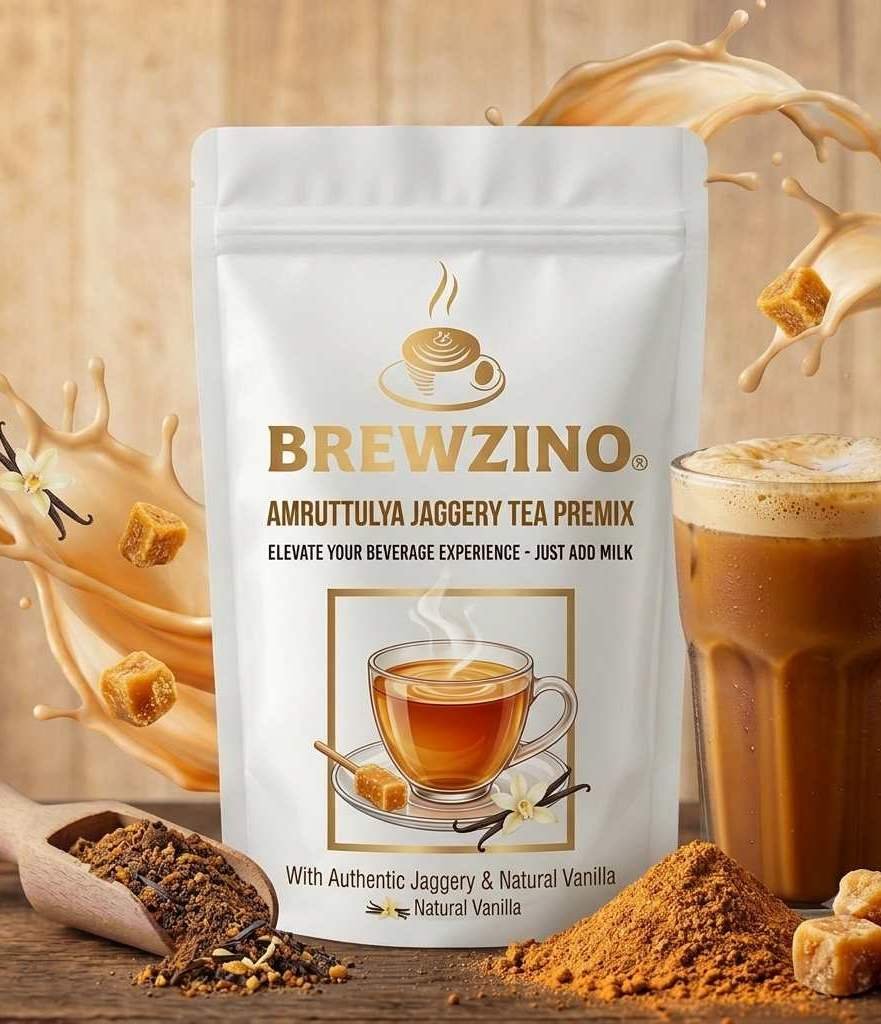
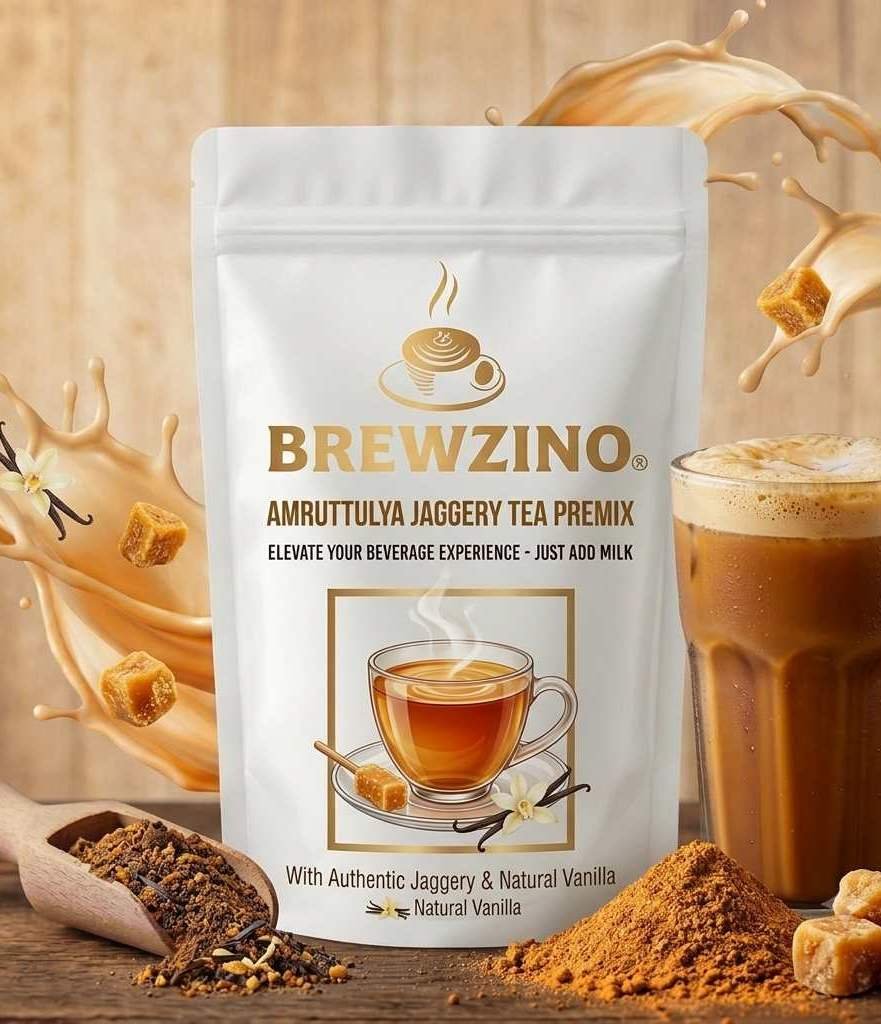
Jaggery tea — chai brewed with unrefined cane or palm jaggery instead of refined white sugar — has moved from a home-kitchen staple across North and West India into café and HORECA menus as a "healthier chai" option with real mineral content and a deeper, more rounded sweetness than plain sugar. Brewzino manufactures a full Jaggery Tea Premix range — Cardamom, Ginger, Masala, and the Pune-style Cardamom Amruttulya — each combining premium CTC tea, real spices, and unrefined jaggery into one instant powder, so a café can serve consistent, authentic jaggery chai without brewing loose tea and dissolving jaggery separately for every single cup.
What Is Jaggery Tea?
Jaggery tea is chai made by simmering black tea, milk, and spices with jaggery (unrefined sugarcane or palm sugar) as the sweetener, instead of refined white sugar. Jaggery is minimally processed — cane juice is boiled down and cooled into solid blocks or granules without the refining, bleaching, and crystallisation steps sugar goes through — so it retains natural molasses, trace minerals like iron and potassium, and a deeper, almost caramel-like sweetness that plain sugar can't replicate. The tea itself is brewed exactly the same way as any masala chai; only the sweetener changes, which is why jaggery tea tastes noticeably richer and less flatly sweet than a standard sugar chai.
Why Are Cafés Adding Jaggery Tea to Their Menu?
Indian consumers increasingly read "jaggery" as a more traditional, less processed choice than refined sugar, and cafés have picked up on that shift — a jaggery chai listing signals "authentic" and "wholesome" on a menu board in a way a standard sugar chai doesn't, even though both are fundamentally the same brewed tea. It also gives a café a genuine point of differentiation on a menu that's often crowded with near-identical "masala chai" and "ginger chai" listings, at close to zero extra preparation complexity — the premix brews exactly like any other instant chai mix, just with jaggery already blended in at the right ratio.
What Is Brewzino's Jaggery Tea Premix Made Of?
Every variant in the range — Cardamom, Ginger, Masala, and Cardamom Amruttulya — is built on the same core: premium CTC (crush-tear-curl) black tea, unrefined jaggery as the sole sweetener, and real spices rather than synthetic flavouring. Cardamom Jaggery Tea leans on bold cardamom alone; Ginger Jaggery Tea uses fresh ginger's sharp warmth; Masala Jaggery Tea blends a fuller spice mix (cardamom, ginger, cloves, and cinnamon together) for a rounder, more complex cup; and Cardamom Amruttulya recreates Pune's legendary street-side "nectar" chai style specifically, with an intensely cardamom-forward, velvety profile. All four dissolve directly into simmering milk and water — no separate tea leaves to strain out, no jaggery to melt and stir in on the side.

Why Use a Premix Instead of Brewing Jaggery Chai From Scratch?
Brewing jaggery chai from scratch means stocking loose tea, whole or powdered spices, and jaggery separately, then getting the ratio of all three right, batch after batch, cup after cup — jaggery in particular varies noticeably in sweetness and moisture between batches and suppliers, which makes from-scratch jaggery chai one of the harder drinks to keep truly consistent across shifts. A premix locks that ratio in at the manufacturing stage: the same 15g scoop produces the same strength, sweetness, and spice level whether it's brewed by an experienced chaiwala or a first-day trainee, which matters far more to a multi-outlet chain's quality control than any small saving from sourcing tea, spices, and jaggery separately.
How Is Brewzino's Jaggery Tea Premix Manufactured?
Brewzino's Jaggery Tea Premix range is manufactured in our GMP-compliant, FSSAI-certified facility in Coimbatore, Tamil Nadu. Premium CTC tea is blended in controlled batches with unrefined jaggery and — depending on the variant — cardamom, ginger, cloves, and cinnamon, under hygienic, moisture-controlled conditions that keep the jaggery from clumping or absorbing ambient humidity during processing. Every batch is checked for moisture content, dissolve behaviour, and flavour consistency before packaging, with full batch traceability maintained from raw material intake through to the finished, export-ready pack — the same documentation trail used for both domestic HORECA supply and international export shipments.
What Makes a Good Jaggery Tea Premix?
Quality jaggery tea premix comes down to a few measurable things: colour (a rich amber-brown, not a flat, dull tone that signals over-processed or low-grade jaggery), solubility (it should dissolve cleanly into simmering milk without gritty residue settling at the bottom of the pot), spice balance (cardamom, ginger, or the fuller masala blend should come through clearly rather than being masked by sweetness), and batch-to-batch consistency in both strength and sweetness. Brewzino's range is formulated to hit all four using real CTC tea and real spices rather than tea dust and flavouring extracts, which is what separates a genuinely good jaggery chai from a thin, artificial-tasting one.
Is Jaggery Tea Healthier Than Regular Sugar Tea?
Jaggery retains trace minerals — iron, potassium, magnesium, and small amounts of calcium — that refining strips out of white sugar, along with molasses compounds that give it its deeper flavour and darker colour. It's still a sweetener and should be treated as one on a nutrition label — jaggery isn't meaningfully lower in calories than sugar gram-for-gram — but as a straight swap in a chai recipe, jaggery brings more nutritional content along for the ride than refined sugar does, which is the core of its "healthier chai" positioning on menus and packaging. A milk-based chai preparation with jaggery is best described as a more wholesome treat rather than a health drink outright, but the mineral and molasses content is real, not just marketing.
Does Jaggery Tea Have Caffeine?
Yes — since jaggery tea is brewed from real CTC black tea, a typical cup carries the same caffeine range as a standard cup of Indian masala chai, roughly 30–60mg depending on strength and steep time, noticeably less than a cup of coffee. The jaggery itself contributes no caffeine; it only changes the sweetener, so the caffeine content of jaggery chai and a standard sugar-sweetened chai brewed to the same strength is essentially identical — the difference is entirely in flavour depth and mineral content, not stimulant effect.
How Many Calories Are in a Cup of Jaggery Tea?
A typical 100ml cup of jaggery chai made with Brewzino's premix, milk, and water runs approximately 70–110 calories, depending on how much milk is used and how sweet the cup is brewed. Most of that comes from the milk and jaggery rather than the tea itself, which is calorie-negligible on its own — a café wanting a lighter version can adjust the milk-to-water ratio without changing the premix quantity or spice balance at all.
How Do You Make Jaggery Tea at Home?
- Boil the base: Bring 80ml milk and water together to a gentle boil in a small pan.
- Add the premix: Stir in 15g of Brewzino's Jaggery Tea Premix (Cardamom, Ginger, Masala, or Amruttulya) until fully dissolved.
- Simmer briefly: Let it simmer for 1–2 minutes so the spices and jaggery fully infuse into the milk.
- Strain and serve: Strain into a 100ml glass or cup and serve hot, the same way you would any traditional Indian chai.
What's the Difference Between Cardamom, Ginger, Masala, and Amruttulya Jaggery Tea?
Cardamom Jaggery Tea is built around a single bold spice note — pure cardamom warmth against the jaggery's caramel sweetness, a clean, classic profile. Ginger Jaggery Tea swaps that for fresh ginger's sharper, spicier warmth, popular as a digestive, cold-weather, or monsoon-season chai. Masala Jaggery Tea combines cardamom, ginger, cloves, and cinnamon together for a fuller, more layered spice profile closer to a classic masala chai. Cardamom Amruttulya is the most distinctive of the four — a specific recreation of Pune's legendary "Amruttulya" street-chai style, meaning "nectar-like," known for an especially velvety texture and intensely cardamom-forward character that's built a cult following of its own across Maharashtra.
What Is Amruttulya Chai and Why Is It Famous?
Amruttulya tea stalls are a Pune institution — small, often decades-old chai shops built entirely around one intensely flavoured, cardamom-forward, velvety-textured cup of tea, served fast and cheap to a loyal daily customer base. The name itself means "equal to nectar" in Marathi, reflecting just how strongly regulars feel about the specific flavour profile these stalls have refined over generations. Brewzino's Cardamom Amruttulya Jaggery Tea Premix is formulated specifically to recreate that bold, velvety, cardamom-heavy profile — naturally sweetened with jaggery rather than the refined sugar most original Amruttulya stalls still use — giving a café outside Maharashtra a genuine way to offer this specific, well-known chai style rather than a generic "masala chai" that misses what actually makes Amruttulya distinctive.
Is Jaggery Tea Gluten-Free?
Yes. CTC tea, jaggery, and the whole spices used across Brewzino's range (cardamom, ginger, cloves, cinnamon) are all naturally gluten-free, making jaggery tea suitable to list as gluten-free on a menu without needing a separate formulation. As with any milk-based drink, the milk itself is the only ingredient to flag separately for customers checking for dairy-free options, not the premix.
Who Uses Jaggery Tea Premix?
Traditional tea stalls, cafés, HORECA chains, cloud kitchens, and food manufacturers across India and Brewzino's 30+ export markets use jaggery tea premix — particularly outlets positioning themselves around "authentic" or "traditional" chai experiences, where a jaggery-sweetened option gives real differentiation from the standard sugar-chai most competitors serve. It's also popular with health-conscious cafés wanting a chai option that reads as more wholesome without adding an entirely new drink category to train staff on.
How Does Jaggery Tea Compare to Regular Sugar Tea?
Against a standard sugar-sweetened chai, jaggery tea has a deeper, rounder, almost caramel-toned sweetness rather than sugar's flatter, one-dimensional sweetness, plus the trace minerals jaggery retains that refined sugar doesn't. It's also generally positioned as the more "premium" or "traditional" option on a menu, often priced at a modest step up from standard sugar chai to reflect that positioning — the making cost difference between jaggery and sugar as raw ingredients is minor, so the price gap is mostly about menu positioning rather than actual cost.
What Mistakes Should You Avoid When Making Jaggery Tea?
The most common mistake is boiling too aggressively or too long after adding the jaggery, which can make the milk split or give the tea a slightly burnt, bitter edge — a gentle simmer for a minute or two is enough. The second is under-dissolving, leaving grainy jaggery residue at the bottom of the cup rather than a smooth finish; stirring continuously while the premix is added avoids this. The third is assuming all jaggery tastes the same and skipping a proper premix altogether — raw jaggery varies significantly batch to batch in sweetness and moisture, which is exactly the inconsistency a manufactured premix is designed to remove.
How Should You Store Jaggery Tea Premix?
Store the sealed pack in a cool, dry place away from direct heat and moisture — jaggery is naturally hygroscopic (it absorbs moisture from the air), and damp storage conditions can cause the premix to clump or harden over time. Reseal the pack tightly after each use rather than leaving it exposed. Properly stored, Brewzino's Jaggery Tea Premix range carries an 18-month shelf life from the manufacturing date, suitable for both fast-turnover café use and slower retail stock.
How Is Jaggery Tea Premix Packaged?
Brewzino ships the Jaggery Tea Premix range in moisture-proof, food-grade packaging across multiple sizes — from 100g sachets and 500g retail pouches up to 5kg, 10kg, and 25kg bulk bags for HORECA and manufacturing use, all suitable for container export. Sizing the pack format to the actual buyer — a small retail pouch for a single café versus an industrial sack for a manufacturer — keeps packaging waste proportionate across the full range of order volumes Brewzino ships.
Where Can You Buy Jaggery Tea Premix in Bulk in India?
If you're a café owner, tea-stall operator, HORECA business, or food manufacturer, Brewzino manufactures and exports the full Jaggery Tea Premix range directly from our FSSAI-certified facility in Coimbatore, Tamil Nadu. MOQ starts at 50kg (negotiable for trial orders), with private label available for B2B buyers and samples shipped worldwide via the Order Sample option, so you can confirm flavour, sweetness, and dissolve behaviour before committing to a bulk order.
Can You Get Jaggery Tea Premix Under Your Own Brand?
Yes. Brewzino offers full private label and custom formulation across the Jaggery Tea Premix range — your own branding and packaging, with Brewzino handling manufacturing, sourcing, and quality control, and spice intensity or sweetness adjustable to match your own house recipe. This is available from relatively modest order volumes, making it practical for a single tea stall or café building its own retail line, not just large multi-outlet chains standardising a house blend.
What Should You Check Before Ordering Jaggery Tea Premix?
Before committing to a bulk order, check which variant matches your menu positioning (Cardamom for a classic profile, Ginger for a spicier cold-weather chai, Masala for a fuller blend, or Amruttulya for the specific Pune-style cup), the certifications held by the manufacturer (FSSAI, APEDA, and IEC for export), the packaging formats available for your order size, the shelf life and storage conditions, and whether private label is available if you plan to sell under your own brand. Requesting a sample before a bulk order remains the most reliable way to confirm the flavour and sweetness actually match what your menu needs.
Final Thoughts: Should You Add Jaggery Tea to Your Menu?
Jaggery tea gives a café or tea stall a genuine point of differentiation on an otherwise crowded chai menu, backed by real mineral content and a deeper flavour that refined sugar can't match — and Brewzino's range covers everything from a classic Cardamom cup to the specific, cult-favourite Amruttulya style, all built on real CTC tea and real spices rather than flavouring extracts. Ready to add jaggery tea to your menu? View the Cardamom Jaggery Tea, Ginger Jaggery Tea, Masala Jaggery Tea, or Cardamom Amruttulya Jaggery Tea Premix product pages to request a sample or a bulk quote.
Is Jaggery Tea Suitable for Export Markets?
Jaggery-based food and beverage products have strong recognition across South Asian diaspora markets — the Middle East, Southeast Asia, the UK, and North America all carry significant Indian and Sri Lankan populations familiar with jaggery as a traditional sweetener, which makes jaggery tea premix a natural fit for export alongside Brewzino's other tea and coffee ranges. Every batch is manufactured under the same FSSAI, APEDA, and IEC-certified process used across Brewzino's full catalogue, with full documentation support (certificates of origin, phytosanitary paperwork, and batch traceability records) for buyers importing into any of Brewzino's 30+ current export destinations.
How Do Cafés Price Jaggery Tea on Their Menu?
Jaggery tea typically commands a modest premium over standard sugar chai — usually 10 to 20 percent higher — reflecting its positioning as the more traditional, "better-for-you" option rather than a basic commodity chai. That premium is easy to justify to customers once the jaggery-versus-sugar distinction is called out clearly on the menu (a short line like "brewed with jaggery, not refined sugar" does most of the work), and because the premix keeps the making cost predictable regardless of who's behind the counter, the margin on that premium holds steady across every outlet and every shift rather than eroding as staff turn over.
Frequently Asked Questions About Jaggery Tea Premix
Can jaggery tea be made without milk? Yes — brew the premix in hot water alone for a lighter, black-tea-style jaggery chai, popular with customers who prefer a dairy-free or lower-calorie option, though the classic milk-based preparation remains the more common café listing.
Does the jaggery in the premix ever crystallise or harden in the pack? Properly sealed and stored away from humidity, no — jaggery's tendency to absorb moisture is exactly why Brewzino packages the range in moisture-proof, food-grade pouches and bags rather than standard packaging, and why resealing the pack tightly between uses matters more for this range than for a plain sugar-based tea premix.
Is one variant more popular than the others? Masala Jaggery Tea and Cardamom Amruttulya tend to see the strongest repeat orders — Masala because it reads as the most familiar "complete" chai flavour to a broad customer base, and Amruttulya because it taps into a specific, well-known regional chai culture that customers actively seek out by name rather than just ordering "a chai."
Can the spice blend be customised for a private label order? Yes — Brewzino can adjust cardamom, ginger, or overall spice intensity, as well as sweetness level, to match a buyer's own house recipe as part of a private label or custom formulation order, rather than shipping only the standard formulation under a new label.
What Equipment Do You Need to Serve Jaggery Tea?
No special equipment beyond what a café already uses for standard chai — a stovetop or induction burner, a saucepan for simmering, a fine strainer, and serving cups. Because the tea, spices, and jaggery are already blended and measured into a single scoop, there's no separate jaggery-melting step or spice-grinding equipment required, which means a café can add the full four-variant Jaggery Tea range to its menu using the exact same prep station and equipment already in place for its existing chai offerings.
How Does Jaggery Tea Fit Into a Broader HORECA Beverage Menu?
For hotels, restaurants, and catering operations running a full beverage program, jaggery tea slots naturally alongside filter coffee, masala chai, and other traditional Indian beverages already on the menu, rather than requiring a separate category or explanation to guests. It works equally well as an in-room dining item, a banquet and event service pour, or a lobby/reception offering positioned as a distinctly Indian, premium alternative to a generic tea bag. Because the premix brews in the same equipment and timeframe as any other instant chai mix, kitchen and F&B teams can add it to room-service and banqueting menus without retraining staff or sourcing new brewing equipment, which is often the deciding factor for a hotel group evaluating whether a new beverage SKU is worth adding across dozens of properties.
Does Brewzino Offer Trial Quantities Before a Full Bulk Order?
Yes — while the standard MOQ for the Jaggery Tea Premix range is 50kg, Brewzino works with new B2B buyers on negotiated trial quantities specifically so a café, hotel group, or distributor can test the product in real service conditions — actual customer feedback on taste and repeat orders — before committing to a full bulk shipment. Samples are also shipped globally through the Order Sample option on each product page, letting a buyer confirm flavour, sweetness, and dissolve behaviour firsthand ahead of even a trial order, which is the recommended first step for any buyer new to the jaggery tea category.
Key Takeaways
- Jaggery tea = CTC black tea + milk + real spices + unrefined jaggery (instead of refined sugar).
- Four variants: Cardamom, Ginger, Masala, and the Pune-style Cardamom Amruttulya.
- ~30–60mg caffeine per cup, ~70–110 calories for a typical 100ml serving.
- MOQ 50kg (negotiable for trial), private label available, samples shipped worldwide.