
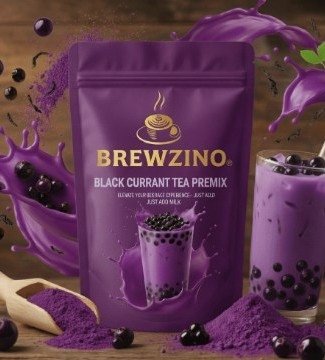
Quick answer: Blackcurrant bubble tea is a tart-sweet, dark purple-red fruit-flavoured premix mixed with milk or water and chewy tapioca pearls. It contains no tea or coffee, so it's naturally caffeine-free. A typical cup has ~250–350 calories. Brewzino manufactures and exports Blackcurrant Bubble Tea Premix from Coimbatore, India, MOQ 5 kg (negotiable for trial orders), with private label and free samples available.
What Is Blackcurrant Bubble Tea?
Blackcurrant bubble tea is a fruit-flavoured bubble tea made with blackcurrant — a small, dark purple-red berry known for its tart, tangy flavour and deep colour. It's typically made by mixing a blackcurrant-flavoured premix with milk or water, then serving it with chewy tapioca pearls ("boba") at the bottom of the glass, hot or over ice, sometimes as a milk tea and sometimes as a lighter, non-dairy "fruit tea" style drink.
Blackcurrant is a well-established, widely recognised flavour internationally — familiar from cordials, jams, sweets, and juices — which makes blackcurrant bubble tea an easy sell to customers who already know and like the taste, even if they haven't tried it in bubble tea form before.
Where Does Blackcurrant Bubble Tea Come From?
Blackcurrants have been cultivated in Europe for centuries, particularly popular in the UK, Scandinavia, and parts of Central and Eastern Europe, where the tart berry is a staple in jams, cordials, and desserts. Blackcurrant cordial in particular became a household staple in Britain, especially after being promoted as a vitamin C-rich drink during and after the Second World War, when citrus imports were scarce. That familiarity carried the flavour into countless other products over the decades — sweets, sodas, and now, fruit-flavoured bubble tea.
Bubble tea itself started in Taiwan in the 1980s, when tea shops began experimenting with adding tapioca pearls and shaking tea with milk and ice — creating a playful, textured drink format that quickly became a youth-culture phenomenon before spreading through Hong Kong, mainland China, and the rest of East and Southeast Asia through the 1990s and 2000s. As bubble tea menus expanded internationally, fruit flavours — including berries like blackcurrant, strawberry, and blueberry — became a natural addition alongside the original tea-based flavours, offering a lighter, tangier alternative for customers who prefer fruit over milk tea.
What Is Blackcurrant Bubble Tea Made Of?
A standard blackcurrant bubble tea has three core components:
- Blackcurrant-flavoured premix: A blend of blackcurrant flavouring with sweetener (and creamer, for a milk tea version) — the flavour, colour, and body base of the drink.
- Milk or water: Milk for a creamier milk tea style, or water for a lighter fruit tea style.
- Tapioca pearls (boba): Chewy balls made from tapioca starch, usually cooked in a brown sugar syrup before being added to the drink.
Brewzino's Blackcurrant Bubble Tea Premix is formulated from premium quality ingredients with no artificial additives, dissolving instantly for a consistent result whether prepared hot or cold. All that's left to do is mix with water or milk and add cooked tapioca pearls.
Why Use Blackcurrant Premix Instead of Fresh Blackcurrant Fruit?
Making blackcurrant bubble tea from fresh or frozen blackcurrants would mean straining out seeds and skins, cooking down the fruit with sugar to balance its natural tartness, and doing this fresh for every batch — impractical for a café serving many cups a day, and inconsistent from batch to batch depending on the fruit's ripeness. A blackcurrant bubble tea premix like Brewzino's delivers the same tart-sweet flavour and colour in an instant-dissolve powder, with no seeds, straining, or cooking required, and identical results every time.
This consistency is exactly why most bubble tea cafés and HORECA chains use a premix rather than working with fresh fruit. It also cuts prep time per cup from several minutes down to under a minute, which matters a lot during a lunchtime or evening rush.
How Blackcurrant Bubble Tea Premix Is Manufactured
Our Blackcurrant Bubble Tea Premix is manufactured under strict GMP-compliant conditions with full traceability. The process runs through six stages:
- Raw Material Sourcing — Premium ingredients sourced from FSSAI-approved certified suppliers.
- Quality Testing — All incoming materials tested before processing begins.
- Blending — Precision blending in our GMP-certified facility.
- Processing — Fine milling for uniform particle size and instant dissolve.
- QC Release — Finished product tested before dispatch.
- Packing & Export — Packed in food-grade moisture-proof packaging with full export documentation.
What Makes a Good Blackcurrant Bubble Tea Premix
With a tart fruit flavour like blackcurrant, the fundamentals of quality are straightforward but important: a natural-tasting flavour rather than an artificial, one-dimensional sweetness; consistent colour and taste from batch to batch; and a powder that dissolves instantly without gritty residue. Brewzino's Blackcurrant Bubble Tea Premix is made from premium quality ingredients with no artificial additives, and dissolves instantly for consistent quality in every batch.
Beyond the flavour itself, a few practical markers of quality are worth checking with any supplier: whether the product is suitable for both hot and cold preparation (Brewzino's is), whether sweetness and flavour intensity can be adjusted for private label or regional taste preferences, and whether the facility runs batch-level quality testing rather than only checking the finished product at the end.
Is Blackcurrant Bubble Tea Good For You?
Fresh blackcurrants themselves are well known for a naturally high vitamin C content and antioxidant compounds — one of the reasons the fruit became popular in cordials and juices in the first place. That said, it's important to be honest about what a bubble tea premix is: a flavoured, sweetened powder, not a source of fresh fruit nutrition. Brewzino has not published specific nutrient or antioxidant claims for this premix, so it's best enjoyed as a flavourful treat rather than assumed to carry the same nutritional profile as fresh blackcurrant fruit.
Like any sweetened bubble tea, moderation is the sensible approach — the tapioca pearls and added sweetener contribute meaningfully to the drink's sugar and calorie content regardless of the fruit flavour used.
Does Blackcurrant Bubble Tea Have Caffeine?
No. Blackcurrant bubble tea premix does not contain any tea leaves or coffee as ingredients — per Brewzino's own product formulation, it's a flavoured premix, which means it's naturally caffeine-free.
Some cafés do offer a caffeinated "fruit tea" version by blending a fruit-flavoured premix like this with a separately brewed black or green tea base — a common bubble tea café preparation style — but that's a deliberate choice made at the café counter, not something inherent to the blackcurrant premix itself. If caffeine content matters to you, it's worth asking the café directly whether their specific preparation adds a brewed tea base on top of the premix.
How Many Calories Are in Blackcurrant Bubble Tea?
A typical 300ml cup made with premix, milk or water, and tapioca pearls has roughly 250–350 calories for a milk tea version (lighter, non-dairy fruit tea versions typically run somewhat lower), depending on preparation and how much sweetener and pearls are added. These are general estimates, not lab-tested values for any specific recipe:
| Component | Calories | |---|---| | Blackcurrant premix (25–30g) | ~roughly 80–110 kcal | | Milk (150–200ml, milk tea version) | ~roughly 90–130 kcal | | Tapioca pearls (30–50g cooked) | ~roughly 70–110 kcal | | Typical total, milk tea version (300ml cup) | ~roughly 250–350 kcal |
For a lighter version, choose the water-based fruit tea style instead of milk, use less sweetener, or ask for fewer pearls — all three noticeably bring the total down.
Is Blackcurrant Bubble Tea Sweet? Sugar & Low-Sugar Options
Yes — blackcurrant is naturally tart, almost sour on its own, so it's typically sweetened to balance that tartness, and the tapioca pearls themselves are cooked in a brown sugar syrup, adding further sweetness. For a lower-sugar version: ask for less added sweetener (most cafés offer adjustable sugar levels), choose water instead of milk, and go easy on the pearls, or skip them for a "no-pearl" version instead.
Is Blackcurrant Bubble Tea Gluten-Free and Vegan-Friendly?
The core ingredients — flavoured premix, milk or water, and tapioca pearls — are naturally gluten-free. Always check the specific ingredient list of the premix and any added flavourings, and confirm allergen/cross-contact details with the supplier if you have coeliac disease or a severe gluten allergy.
For a vegan version, either prepare it as a water-based fruit tea (no dairy at all) or swap dairy milk for a plant-based milk (oat, soy, or almond) for a milk tea style — both work well with a blackcurrant flavour base.
How Do You Make Blackcurrant Bubble Tea at Home?
Here's a simple recipe you can make at home with Brewzino's Blackcurrant Bubble Tea Premix:
- Cook the pearls: Boil tapioca pearls in water for 20–25 minutes, then let them rest off the heat for 15 minutes. Soak the cooked pearls in a little brown sugar syrup so they don't stick together.
- Mix the blackcurrant base: Stir 25g of blackcurrant bubble tea premix into 200ml of hot milk or water until fully dissolved.
- Assemble: Add the sweetened tapioca pearls to the bottom of a glass, fill with ice for an iced version.
- Pour and serve: Pour the blackcurrant mixture over the ice and pearls (or serve warm for a hot version), stir once, add a wide bubble-tea straw, and serve immediately.
Adjust the premix quantity to taste — increase for a stronger, more intense blackcurrant flavour, as noted on the pack.
What Are the Different Ways to Serve Blackcurrant Bubble Tea?
Blackcurrant bubble tea premix isn't limited to one format. Here are the main ways cafés and home brewers serve it:
- Hot Preparation: Mix 25g premix in 200ml hot milk or water. Stir and serve.
- Cold Preparation: Mix 30g in 150ml cold water. Pour over ice and serve.
- Blended Drink: Blend with ice and milk for a smooth frozen beverage.
- Desserts: Use as a flavour base for desserts, ice cream, and baked goods.
How Is Blackcurrant Bubble Tea Different From Blackcurrant Cordial?
Blackcurrant cordial — the classic diluted-syrup drink familiar in the UK and parts of Europe — is simply concentrate mixed with water, served cold with no toppings and a thin, juice-like texture. Blackcurrant bubble tea shares the same core flavour but is a fundamentally different drink experience: it's typically mixed with milk or water into a fuller-bodied base and always served with chewy tapioca pearls, giving it texture and richness a cordial never has.
Compared with a plain blackcurrant fruit tea (brewed tea plus blackcurrant flavouring, no milk), blackcurrant bubble tea can go either way — milk tea style for a creamier, more indulgent drink, or fruit tea style for a lighter, more refreshing one. Both are legitimate, popular preparations, and a good premix should work for either.
| | Cordial | Bubble Tea | |---|---|---| | Texture | Thin, juice-like | Fuller-bodied, with chewy pearls | | Base | Water only | Milk or water, café's choice | | Toppings | None | Tapioca pearls, optional jellies |
How Does Blackcurrant Compare to Other Bubble Tea Flavours?
Blackcurrant sits within the fruit-flavour category of bubble tea, alongside options like strawberry, blueberry, and lychee — flavours that offer a tangier, lighter alternative to milk-tea-forward flavours like matcha or taro, bubble tea's two best-selling flavours worldwide. Its tart, less overtly "fruity-sweet" profile (compared with strawberry or lychee, for instance) gives it a slightly more grown-up, less candy-like appeal, which can work well alongside sweeter fruit options on the same menu.
For a deeper look at how one of bubble tea's most popular, more traditional flavours compares on taste, target customer, and café profitability, see our companion article: Matcha Bubble Tea Premix in India — The Complete Guide.
Who Uses Blackcurrant Bubble Tea Premix?
Blackcurrant Bubble Tea Premix isn't limited to dedicated bubble tea shops — it's a flexible base ingredient used across several parts of the food and beverage business:
- Bubble Tea Cafés: Premium beverage base for café menus.
- Coffee Shops: Add variety to your beverage menu.
- Hotels & Restaurants: Premium beverage option for hotel and restaurant menus.
- HORECA Supply: Bulk supply to food service chains.
- Food Manufacturers: Ingredient for beverages, ice cream, and desserts.
- Export Distributors: Export-ready supply to global markets.
How Does Blackcurrant Bubble Tea Compare to Other Popular Drinks?
It helps to place blackcurrant bubble tea alongside other everyday drinks people compare it to when deciding what to order:
| Drink | Profile | |---|---| | Blackcurrant bubble tea (300ml) | ~roughly 250–350 kcal (milk tea), no caffeine, tart-sweet, chewy pearls | | Blackcurrant cordial/squash (250ml diluted) | ~roughly 60–100 kcal, no caffeine, thin texture, no toppings | | Cola (300ml) | ~roughly 120–140 kcal, ~30–40mg caffeine, high sugar, no functional benefits | | Fresh fruit juice (300ml) | ~roughly 120–160 kcal, no caffeine, natural sugars, vitamin content varies |
These are typical ranges, not lab-tested values for any specific brand — actual numbers vary by recipe, brand, and serving size. The useful comparison here: blackcurrant bubble tea sits closer to a dessert-drink than a plain cordial or juice in calories and richness, thanks to the milk and tapioca pearls, while offering a distinctly tarter flavour profile than sweeter fruit bubble tea options.
What Mistakes Should You Avoid When Making Blackcurrant Bubble Tea at Home?
Blackcurrant bubble tea is simple to make, but a few common mistakes affect the result:
- Under-sweetening and leaving it too tart: Blackcurrant's natural tartness needs balancing with sweetener — taste and adjust before serving rather than assuming the premix alone is fully balanced for your preference.
- Not dissolving the premix fully: Undissolved premix settles at the bottom as a gritty layer. Stir thoroughly, or use a small whisk for a smoother finish.
- Overcooking or undercooking tapioca pearls: Undercooked pearls stay hard in the centre; overcooked pearls turn mushy and lose their chew. Follow the pack's cook time closely and test one pearl before draining the batch.
- Letting cooked pearls sit too long unsweetened: Pearls harden as they cool. Keep them in sugar syrup and use within a few hours of cooking for the best texture.
- Assuming a fruit flavour automatically means healthier: A sweetened blackcurrant bubble tea still carries meaningful sugar and calories from the pearls and sweetener, regardless of the fruit association.
How Should You Store Blackcurrant Bubble Tea Premix?
Brewzino's Blackcurrant Bubble Tea Premix has a shelf life of 18 months when sealed and stored correctly. A few practical storage guidelines:
- Keep it sealed: Reseal the pouch or bag tightly after each use to limit moisture and air exposure, which are the main causes of clumping and flavour loss in powdered premixes.
- Store cool and dry: Avoid direct sunlight, humidity, and heat sources (like near a stove or window). A pantry shelf or cool storage room works well for both retail packs and bulk bags.
- Use within shelf life once opened: While the sealed shelf life is 18 months, an opened pack is best used within a few months for peak flavour and colour, even if stored correctly.
- Watch for clumping or off-smells: If the premix has visibly clumped hard, changed colour, or developed an off smell, it's past its best and shouldn't be used.
How Is Blackcurrant Bubble Tea Premix Packaged Sustainably?
Packaging plays a real role in both product quality and environmental impact for a powdered premix like this. Brewzino packs Blackcurrant Bubble Tea Premix in moisture-proof, food-grade packaging — sachets, resealable pouches, or bulk sacks — designed to protect the product through shipping and storage while minimising spoilage-related waste, since a well-sealed pack that keeps its full shelf life directly reduces food waste compared to poorly packaged premix that clumps or spoils early.
For café and business buyers, choosing bulk pack sizes (5kg, 10kg, or 25kg) over multiple small retail packs also reduces packaging material per kilogram of product — worth considering for high-volume operations that go through premix quickly and don't need individual retail-size units.
Is Blackcurrant Bubble Tea Trending in India?
Fruit-flavoured bubble teas have grown steadily on Indian café menus alongside classic tea-based flavours, as bubble tea shops in Chennai, Bengaluru, Mumbai, and Delhi NCR broaden their menus to include lighter, tangier options for customers who prefer fruit tea over milk tea. Blackcurrant fits into this trend as a slightly more distinctive choice than very common fruit flavours like strawberry or mango — its tartness and deep colour give it a point of difference on a menu, appealing to customers looking for something less straightforwardly sweet.
For café owners, blackcurrant also works well as a seasonal or rotating-menu item, since it's less commonly seen than mango or strawberry on Indian bubble tea menus, which can help it stand out to repeat customers looking for variety.
How Do Cafés Price Blackcurrant Bubble Tea?
Fruit-flavoured bubble teas like blackcurrant typically retail for ₹110–₹170 per cup in Indian cafés, broadly in line with other fruit flavours on the menu. Because premix keeps ingredient cost low and consistent, cafés using a blackcurrant bubble tea premix like Brewzino's typically see 70–75% profit margins per cup.
Actual retail pricing varies by city and format: premium mall-based or specialty cafés in metros tend to sit at the higher end of that range or above it, while smaller standalone bubble tea kiosks in tier-2 cities typically price closer to the lower end. Toppings (extra pearls, fruit jellies, popping boba) and size upgrades are the usual levers cafés use to increase average order value on top of the base cup price.
Where Can You Buy Blackcurrant Bubble Tea Premix in Bulk in India?
If you're a café owner, HORECA business, or retail brand looking to add blackcurrant bubble tea to your menu, Brewzino manufactures and exports Blackcurrant Bubble Tea Premix directly from our FSSAI-certified, GMP-compliant facility in Coimbatore, Tamil Nadu.
- MOQ: 5 kg (negotiable for trial orders)
- Price: On request — contact Brewzino for a formal quote based on your order quantity
- Packaging: 500g, 1kg, 5kg, 10kg and 25kg
- Shelf life: 18 months, sealed and stored cool & dry
- Certifications: FSSAI, APEDA, IEC
- Export: Shipped via Tuticorin and Chennai to 30+ countries, with full documentation handled in-house
Free samples are available for cafés and businesses who want to trial the premix before committing to a bulk order — see the Blackcurrant Bubble Tea Premix product page to order one or get a price quote.
Can You Get Blackcurrant Bubble Tea Premix Under Your Own Brand?
Want blackcurrant bubble tea premix under your own brand? Brewzino offers complete private label and custom formulation services — your logo, your packaging, our manufacturing. Combined with an MOQ starting at 5 kg and a free sample program, it's a straightforward way for cafés, retail brands, and distributors to launch their own blackcurrant bubble tea line without building a factory. Sweetness and flavour intensity can be adjusted to match your brand's taste profile.
What Should You Check Before Ordering Blackcurrant Bubble Tea Premix?
Before committing to a blackcurrant bubble tea premix supplier, it's worth checking a short list of fundamentals:
- Flavour balance: Ask for a sample and check the tartness and sweetness are well balanced rather than overly artificial or one-note.
- Certifications: FSSAI is mandatory for any food business in India; APEDA and IEC matter if you plan to export.
- Shelf life and storage: Confirm shelf life (18 months is typical) and recommended storage conditions.
- MOQ and trial orders: Look for a supplier willing to negotiate a smaller trial MOQ before you commit to a full bulk order.
- Free samples: A supplier confident in their product should offer a free sample before you buy in bulk.
- Private label support: If you plan to sell under your own brand, confirm private label and custom packaging are available.
- Manufacturing traceability: Ask whether the facility runs quality checks at each production stage rather than only on the finished batch.
- Export documentation support: If you're importing from India, confirm the supplier handles commercial invoices, certificates of origin, and phytosanitary certificates in-house rather than leaving that entirely to you.
Running through this list before placing a bulk order is a quick way to filter out suppliers who can't back up their claims with certifications, testing, or a sample you can actually taste before committing budget to a full shipment.
Final Thoughts: Should You Add Blackcurrant Bubble Tea to Your Menu?
Blackcurrant bubble tea offers Indian cafés a distinctive fruit flavour that stands apart from more common options like strawberry or mango — its tartness and deep colour give it real menu differentiation, and its worldwide familiarity from cordials and jams makes it an easy sell even to first-time bubble tea customers. It works equally well as a creamy milk tea or a lighter fruit tea, giving café owners flexibility in how they position it.
For home brewers, a good blackcurrant bubble tea premix removes the need to work with fresh fruit, straining, and cooking down syrup by hand, turning a fiddly process into something you can make consistently in a few minutes.
If you're evaluating suppliers for a café, HORECA business, or private label brand, Brewzino's Blackcurrant Bubble Tea Premix is manufactured and exported directly from an FSSAI-certified facility in Coimbatore, with free samples available so you can taste it before committing to a bulk order.
