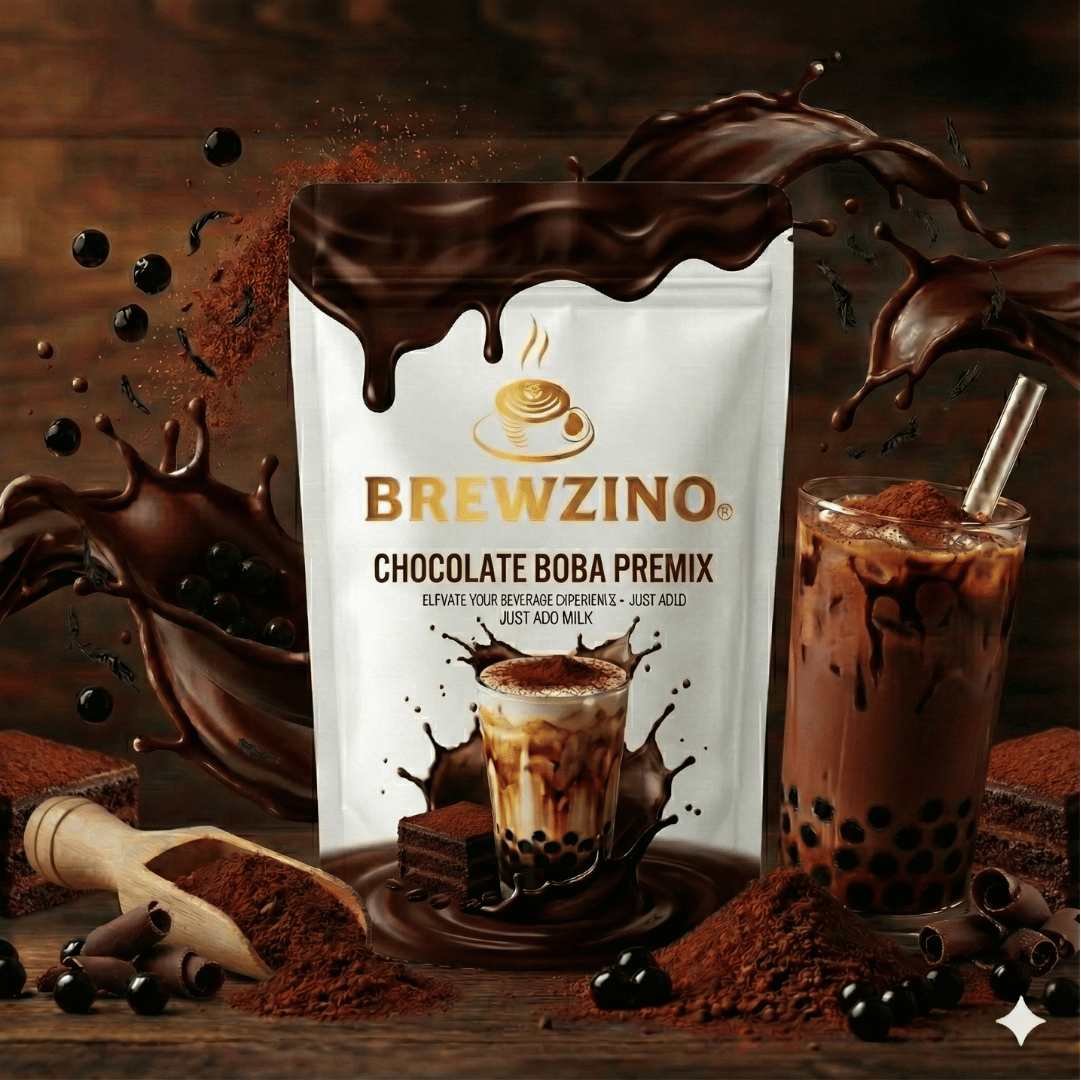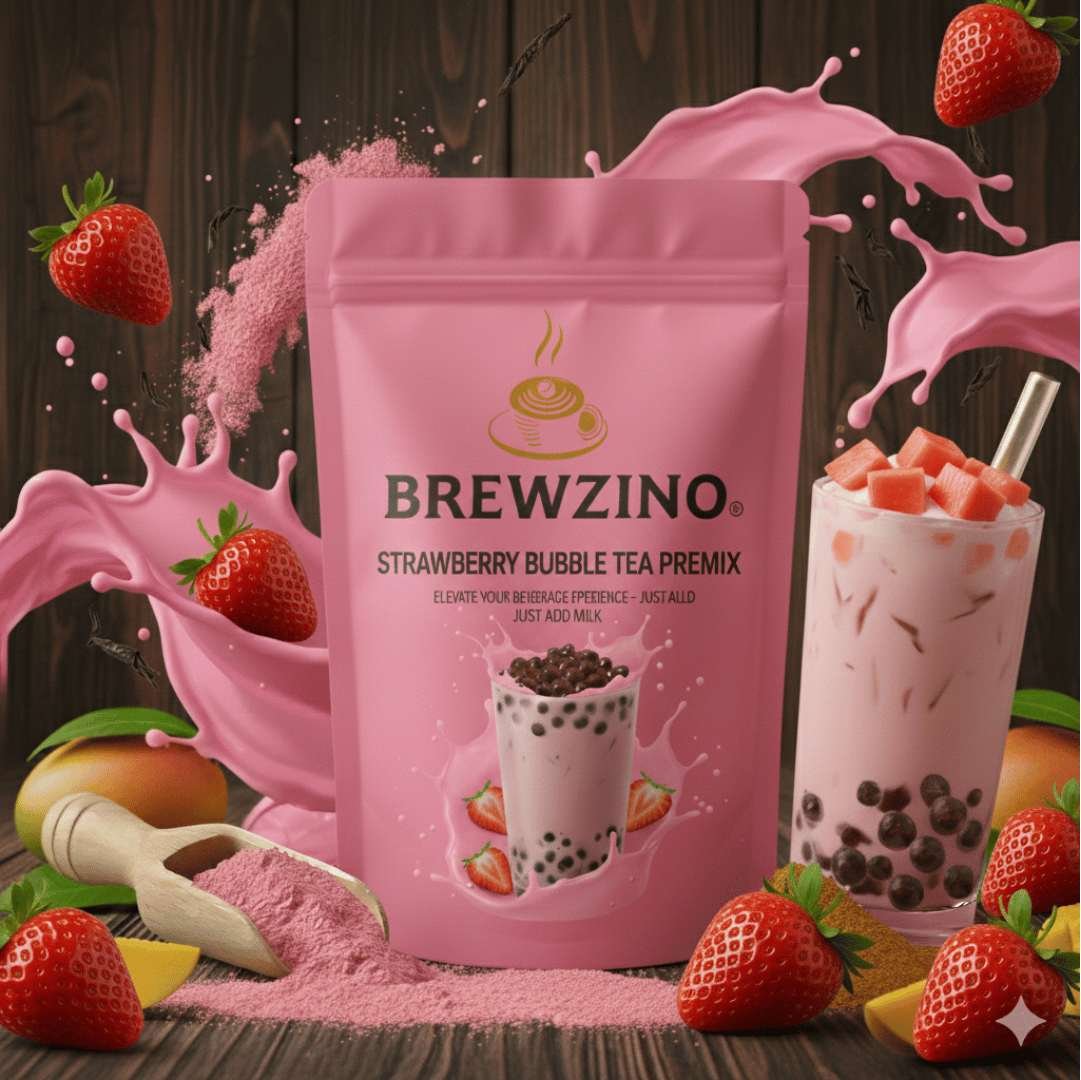
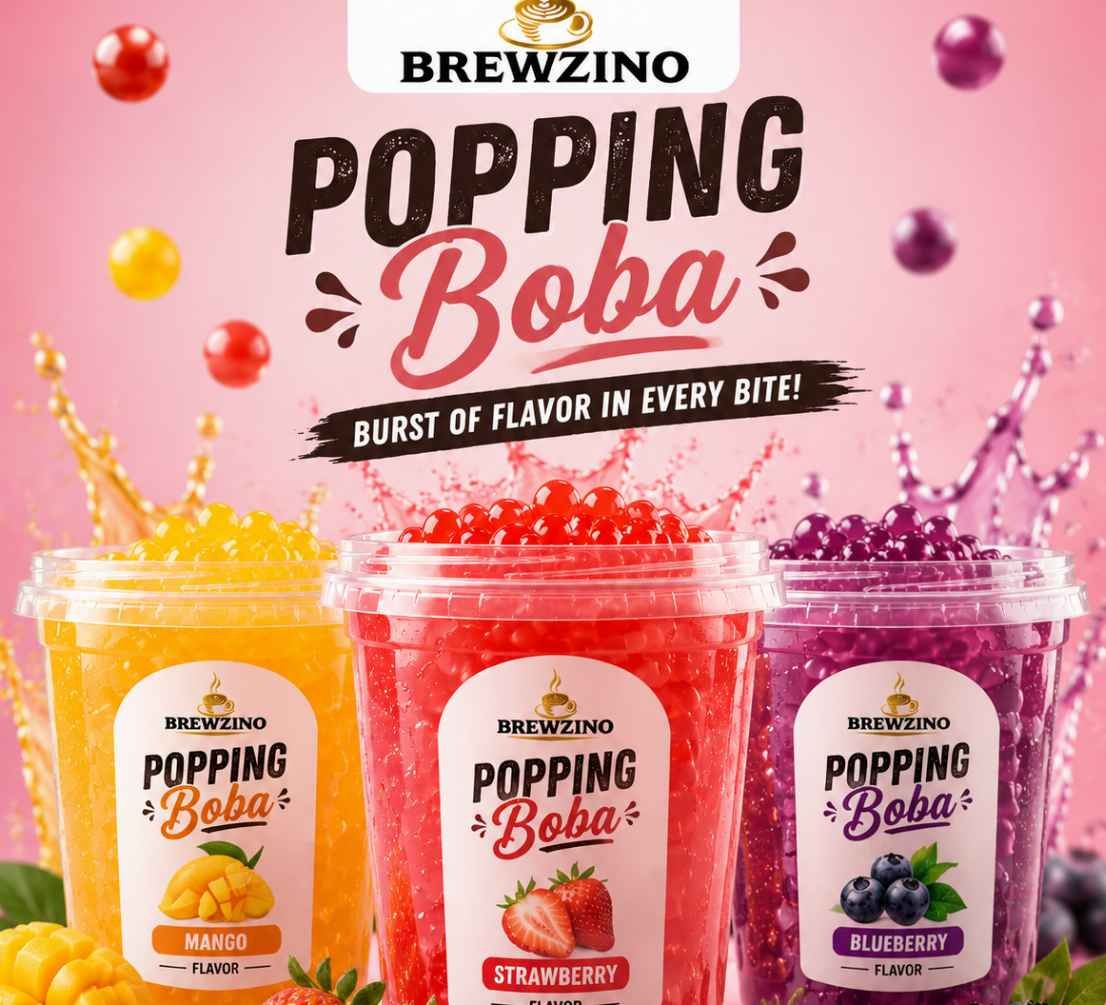
Running a cafe, coffee shop, or franchise usually means managing a handful of different suppliers just to keep the beverage menu stocked — one for bubble tea, another for coffee, a third for tea premix. Brewzino was built to remove that complexity.
Everything Under One Roof
Brewzino manufactures bubble tea premix (Matcha, Taro, Hongkong-style, Thai Milk Tea, Chocolate, and more), boba pearls, cold coffee premix, instant coffee, milk premix, jaggery tea premix, and sugar tea premix — all from the same GMP-compliant facility in Coimbatore, Tamil Nadu. One supplier relationship, one quality standard, one delivery to track instead of four.
Built for Every Format
The same product range works whether you're a single independent cafe testing a new menu category, a coffee shop adding bubble tea as a complementary line, or a multi-outlet franchise that needs every location pouring an identical cup. Formats span powder, granules, instant sachets, and bulk bags, so ordering scales from a single cafe's daily service up to full container quantities.
Quality You Can Verify
This isn't just a claim — Brewzino holds FSSAI certification for food safety, is registered with APEDA for agricultural exports, and carries an IEC for direct international shipping. Every batch is tested in-house for taste, colour, moisture content, microbial counts, and dissolve performance before it leaves the facility.
Private Label, If You Want It
For businesses that want the product under their own name, Brewzino offers private label and custom formulation — your packaging and branding, with flavour and sweetness adjusted to your specification, backed by the same manufacturing and quality control.
Getting Started with Samples
Because switching suppliers is a real decision, Brewzino ships free samples globally so you can test the range firsthand — flavour, colour, and dissolve performance — before committing to a bulk order. ## Why Does Sourcing From Multiple Suppliers Actually Cost You More?
Beyond the obvious hassle of managing four or five vendor relationships, splitting your beverage sourcing across separate suppliers for bubble tea, coffee, and tea premix carries real, often invisible costs. Each supplier has its own minimum order quantity, meaning you either over-order on slower-moving items to hit a MOQ or under-order and pay a premium for smaller batches. Each has its own delivery schedule, meaning stock-outs on one ingredient can happen independently of the others, disrupting your menu unpredictably. Each has its own quality standard — or lack of one — meaning a "consistent" cup on your menu is really only as consistent as your least reliable vendor. And each represents a separate relationship to manage, a separate invoice to reconcile, and a separate point of failure if that vendor has a bad batch, a delivery delay, or simply goes out of business. Consolidating that sourcing into a single manufacturer doesn't just simplify your operations on paper — it removes several real, recurring risks from your supply chain at once.
How Does Brewzino's Range Actually Cover a Full Beverage Menu?
A café or franchise building a genuinely complete beverage menu typically needs five categories: a tea-based cold drink (bubble tea), a topping (boba pearls), a coffee-based cold drink (cold coffee premix), a hot beverage base (instant coffee and jaggery/sugar tea premix), and a milkshake-style option (milk premix). Brewzino manufactures all five from the same Coimbatore facility — over 20 bubble tea flavours, 9 boba pearl flavours, cold coffee in Classic/Hazelnut/Caramel, three instant coffee grades, four jaggery tea variants, two sugar tea variants, and three milk premix flavours. That's enough range for a full, varied menu without needing to source a single beverage category from anywhere else, which is precisely what "one-stop" means in practice rather than as a marketing phrase.
What Does "Same Quality Standard" Actually Mean in Practice?
When every product category comes from one GMP-compliant, FSSAI-certified facility, "consistent quality" isn't just a claim about any one product — it's a claim about the manufacturing process itself. The same in-house testing protocol that checks a batch of Matcha Bubble Tea Premix for colour, dissolve behaviour, and moisture content is the same protocol applied to a batch of Cold Coffee Premix or Badam Milk Premix. That matters more than it might first appear: a café that's confident in one product line from Brewzino can reasonably extend that confidence to every other product line, rather than having to independently vet the quality of each new category it adds, the way it would if each came from a different, unrelated supplier.
How Does This Work for a Multi-Outlet Franchise Specifically?
For a single café, sourcing simplicity is a convenience. For a multi-outlet franchise, it's closer to a structural requirement. Every outlet needs to serve an identical cup regardless of which flavour, which category, or which specific location is preparing it — a customer's experience at outlet three has to match outlet one exactly, or the franchise brand itself starts to feel inconsistent. That's only realistically achievable when every outlet is drawing from the same batch-tested supply chain rather than each location sourcing locally or improvising with whatever's available nearby. Franchises that standardise their full beverage program — bubble tea, coffee, and tea premix together — on one manufacturer report far fewer quality complaints tied to specific locations than franchises that leave sourcing decisions to individual outlet managers.
What Should You Ask a Supplier Before Consolidating Your Sourcing?
Before moving your full beverage sourcing to a single manufacturer, it's worth confirming a few things directly: Does their range actually cover every category you need, or will you still be sourcing one or two items elsewhere? What certifications do they hold, and can they provide documentation on request rather than just asserting compliance? What is their actual batch-testing process, and is it consistent across every product category or only their flagship line? What happens if you need to place a smaller trial order for a new category — is their MOQ flexible, or does it force you to commit to full volume before you've tested fit? A supplier that answers all four clearly, backed by samples and documentation, is a genuinely different proposition from one that simply has a long product catalogue on paper.
How Do You Transition From Multiple Suppliers to One Without Disrupting Your Menu?
Most operators don't switch every category at once — a more practical approach is to move one category at a time, starting with whichever current supplier is causing the most friction (inconsistent quality, unreliable delivery, or simply the highest cost). Request samples of the equivalent Brewzino product, run it alongside your existing supply for a short comparison period, and confirm it meets or exceeds what you're currently serving before fully switching that category over. Once one category is successfully consolidated, the same process repeats for the next, until your full beverage program runs through a single supplier — a gradual transition that avoids the risk of disrupting your entire menu at once while you confirm fit category by category.
Does Working With One Supplier Limit Your Menu Flexibility?
A common concern with consolidating suppliers is losing access to specialty or niche products a smaller, single-category vendor might offer. In practice, Brewzino's range is broad enough — 20+ bubble tea flavours alone, spanning classic, fruit, and dessert-inspired profiles — that most cafés find they have more flavour options within one supplier's catalogue than they were actually using across several. And because private label and custom formulation are available across every category, a café with a genuinely specific requirement can usually get it built into the standard range rather than needing an entirely separate niche vendor for one item.
Frequently Asked Questions
Can you order a small trial quantity across multiple categories at once, rather than one at a time? Yes — Brewzino's sample program covers the full range, so a café evaluating bubble tea, coffee, and tea premix together can request samples across all three categories in one request rather than testing them sequentially.
Does consolidating suppliers actually reduce cost, or just simplify logistics? Both, in most cases — beyond the logistics simplification, ordering a broader range from one supplier typically qualifies for better combined volume pricing than the same total volume split across several smaller, single-category vendors each with their own margin and minimum order requirements.
What happens if Brewzino discontinues or reformulates a product you rely on? Reformulations are rare and, when they do happen, are communicated to active B2B buyers in advance with sample access to the updated formulation before it replaces the existing one in your regular supply, so there's no unannounced change in what arrives in a routine reorder. ## What Does the Onboarding Process Look Like for a New Café?
A café moving to Brewzino as its single beverage supplier typically follows a straightforward sequence: request samples across the categories you're evaluating, confirm taste, colour, and dissolve performance against your current menu or a new one you're building, place a trial order sized below the standard bulk MOQ to test real service conditions, then move to a regular reorder cycle once the fit is confirmed. Recipe cards and costing sheets are provided alongside the samples, so pricing and preparation are worked out before the first bulk order ships, not figured out after the fact under service pressure.
How Does Brewzino Support Cafés After the Initial Order?
The relationship doesn't end once the first bulk order ships. Ongoing support includes direct access to the product team over phone or WhatsApp for questions on stock levels, storage, or menu sequencing, batch consistency you can verify against your original approved sample on every reorder, and the option to expand into new categories or flavours as your menu evolves, using the same account and delivery relationship rather than starting a new vendor evaluation from scratch. For franchises specifically, this ongoing relationship extends across every new outlet opened under the same brand, so expansion doesn't require re-vetting a supplier at each new location.
What Do Existing Brewzino Partners Typically Start With?
Most new partners begin with bubble tea premix and boba pearls as their first category — usually 4 to 6 flavours to establish a baseline menu — before expanding into cold coffee, instant coffee, or the tea premix ranges once the bubble tea category is running smoothly. This staged approach lets a café validate the supplier relationship on one category before committing to a full five-category switch, while still keeping the door open to consolidate the rest of their beverage sourcing once confidence is established.
Is a One-Stop Supplier Right for Every Type of Business?
A single, broad-range supplier makes the most sense for cafés, coffee shops, and franchises running a genuinely multi-category beverage menu — bubble tea alongside coffee alongside traditional tea, for instance. A business focused narrowly on just one category, such as a dedicated specialty coffee shop with no interest in bubble tea, may not see the same consolidation benefit, since there's only one category to consolidate in the first place. For the broader café and HORECA segment that Brewzino primarily serves, though, the multi-category range is specifically what removes the vendor-juggling problem this article opened with. ## How Does Brewzino's Facility Handle Cross-Category Manufacturing Without Cross-Contamination or Flavour Transfer?
Manufacturing bubble tea premix, coffee, milk premix, and tea premix under one roof raises a fair question: how do you keep a coffee run from picking up notes from the matcha batch made earlier that day, or vice versa? Brewzino's Coimbatore facility runs dedicated blending and packaging lines segmented by product category, with cleaning and changeover protocols between runs specifically designed to prevent flavour carryover — the same discipline a single-category specialist manufacturer would apply, just extended across a wider product range rather than narrowed to one. Batch testing after each production run checks for exactly this kind of contamination before a batch is approved for packaging, which is part of why the same quality assurance process can credibly cover five very different product categories rather than only being rigorous for one flagship line.
What Role Does Export Certification Play in a Domestic Café's Sourcing Decision?
It might seem like FSSAI, APEDA, and IEC certification — all fundamentally export-oriented credentials — shouldn't matter much to a purely domestic café that has no plans to import or export anything itself. In practice, these certifications are a useful, independently verifiable signal of manufacturing discipline regardless of whether a buyer ever touches the export side of the business. A facility that maintains export-grade documentation, batch traceability, and food safety compliance is holding itself to a higher, third-party-audited standard than one that only needs to satisfy basic domestic food safety requirements — which is a meaningful proxy for consistency and quality control even for a buyer who will only ever use the product in one local café.
How Should a Growing Café Chain Think About Supplier Risk?
As a café chain grows from one outlet to several, supplier risk grows with it — a single unreliable vendor that was a manageable inconvenience at one location becomes a brand-wide problem once five or ten outlets depend on the same inconsistent supply. Chains that plan for this early, by standardising on a single, certified, batch-tested manufacturer before problems emerge at scale, generally have an easier expansion path than chains that only address supplier consistency after a bad batch or a stock-out has already damaged customer trust at multiple locations. Consolidating around one supplier isn't just about simplifying today's operations — it's about not having to solve the same sourcing problem five separate times as the business grows.
What's the Realistic Timeline From First Contact to a Fully Stocked Menu?
For a café requesting samples across the full range for the first time, a realistic timeline runs roughly two to four weeks from initial sample request to a fully confirmed menu ready for a first bulk order — a week or so for samples to arrive and be tested internally, time to finalise which flavours and categories to launch with, and a short window to align recipe cards and costing sheets against the finished menu pricing. Franchises coordinating a simultaneous launch across multiple outlets typically build in extra time for internal sign-off across locations, but the underlying supplier-side process — sampling, confirming, ordering — remains the same regardless of how many outlets are involved. ## How Does Private Label Fit Alongside a One-Stop Supply Relationship?
Private label isn't a separate service bolted onto the standard supply relationship — it runs through the exact same manufacturing, testing, and certification process as Brewzino's own retail-labelled products, just packed under the buyer's brand and artwork instead. This matters for a café or chain thinking about eventually launching its own retail line: the consolidation benefit of sourcing every beverage category from one manufacturer extends naturally into a private label decision too, since a chain already sourcing five categories from Brewzino under standard labelling doesn't need a separate manufacturing evaluation to explore private labelling any one of them later. The transition from standard-labelled bulk supply to a private label arrangement is a packaging and branding conversation, not a new supplier vetting process.
Final Thoughts: Is Consolidating Your Beverage Supply Worth It?
The case for a single, broad-range manufacturer comes down to removing variables rather than adding features — fewer vendor relationships to manage, one quality standard to trust instead of several, and a supply chain that scales with you from one outlet to a multi-location franchise without needing to be rebuilt at each stage of growth. Brewzino's range across bubble tea, boba pearls, cold coffee, instant coffee, jaggery tea, sugar tea, and milk premix is built specifically to let a café, coffee shop, or franchise make that consolidation decision once and have it hold as the business grows, rather than revisiting sourcing decisions category by category as new locations or menu items get added. Ready to see whether a single supplier relationship fits your beverage program? Request samples across the range you're evaluating and compare them directly against what you're currently sourcing. ## What Documentation Should You Request Before Your First Bulk Order?
Before committing to a full bulk order across any category, it's reasonable to ask for copies of current FSSAI, APEDA, and IEC certificates, the batch test report for the specific sample lot you evaluated, and — if you're planning to feature certifications on your own menu or packaging — written confirmation of exactly which certifications apply to which product categories, since not every certification necessarily covers every SKU in the same way. A supplier that provides this documentation readily, without friction or delay, is generally signalling the same transparency you can expect throughout the ongoing relationship, not just at the sales stage. A supplier confident in its own process usually shares this information proactively rather than making a buyer ask twice.
How Does Batch Traceability Actually Protect Your Café?
Full batch traceability means that if a quality issue is ever identified in a specific production run, it can be traced back to the exact raw material inputs and production conditions for that batch — and, critically, isolated to that batch alone rather than triggering uncertainty about your entire recent stock. For a café or franchise, this is a real protection: it means a single batch issue, however rare, doesn't cast doubt on every delivery you've received, and it gives you a documented paper trail to point to if a customer ever raises a quality concern about a specific purchase. ## What's the Single Biggest Advantage a One-Stop Supplier Gives a Growing Business?
If there's one advantage that outweighs the rest, it's predictability under growth. A café that adds a second, third, and fourth outlet while sourcing from four different single-category vendors is effectively multiplying its supplier-management overhead at each stage — four vendor relationships become eight, then twelve, as each new location either inherits the same vendors or, worse, sources locally and introduces yet more variation into the menu. A café built on one manufacturer's full range instead scales that same single relationship across every new outlet, with the supplier side of the equation staying constant regardless of how many locations are added. That's the practical, compounding benefit behind "one-stop" — it isn't just simpler on day one, it stays simple on day one hundred.