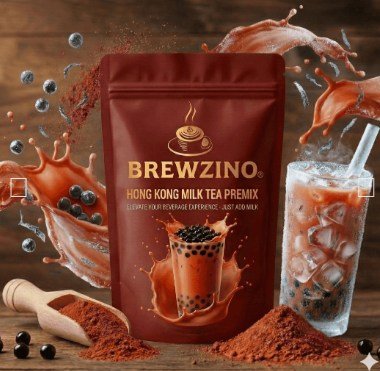
One of the biggest reasons new bubble tea businesses struggle isn't the market — demand is strong across India — it's getting the basics right on day one: mixing ratios, costing, and menu design. That's the gap Brewzino's free guidance is built to close.
What Our Free Guidance Covers
When you work with Brewzino to stock your bubble tea menu, you get more than a box of premix:
- Recipe cards for every flavour, with exact water/milk ratios so the first cup and the hundredth cup taste the same.
- Costing sheets to help you price each size correctly against your ingredient cost, so margins are clear before you print a menu.
- A complimentary sample kit to test flavours and finalise your lineup before ordering in bulk.
- Direct support over phone or WhatsApp for questions on stock levels, boba pearl prep, or menu sequencing.
Who It's For
This is aimed at three groups: first-time cafe owners entering the bubble tea category, existing cafes and coffee shops adding it as a new menu line, and franchise operators who need every outlet to serve an identical cup.
How to Access It
There's no separate sign-up or course fee — this guidance comes as part of working with Brewzino as your premix supplier. Reach out through the website, request samples, and the recipe and costing support comes with it.
Beyond the First Launch
Getting the launch right is only step one. Because Brewzino manufactures the premix itself under FSSAI, APEDA, and GMP compliance in Coimbatore, the same product you tested in your sample kit is what arrives in every reorder — so the training you get upfront keeps paying off with every batch after. ## Why Do Most New Bubble Tea Businesses Get the Basics Wrong?
New operators entering the bubble tea category for the first time typically underestimate how much of the final cup's quality depends on getting simple ratios exactly right, not on any secret ingredient or technique. A slightly wrong premix-to-liquid ratio produces a cup that's too weak, too sweet, or too thin, and without a documented recipe card to check against, staff often "eyeball" the ratio differently from shift to shift, producing a genuinely inconsistent cup even though the premix itself is identical every time. Costing is the second most common gap — many first-time operators price their menu based on what competitors charge rather than working backward from their own actual ingredient cost, which either leaves margin on the table or, just as commonly, prices a drink too low to be profitable once true cost is accounted for.
What Exactly Is Included in a Recipe Card?
Each recipe card documents the exact premix quantity, liquid quantity (water or milk), sweetener adjustment if applicable, ice quantity for a cold preparation, and any topping quantity (tapioca or popping boba) needed to reproduce the sample batch a cafe originally tested and approved. This removes guesswork entirely — any staff member following the card produces the same cup as the one used to finalise the menu, rather than each person developing their own slightly different version of "how we make the matcha bubble tea here."
How Do Costing Sheets Actually Work?
A costing sheet breaks down the exact ingredient cost per cup — premix cost per gram, milk cost per millilitre, topping cost per serving — and totals it against the recipe card's exact quantities, giving an operator a precise making-cost figure before they set a menu price. From there, applying a target margin (commonly 65–78% for premix-based bubble tea) gives a defensible menu price grounded in real numbers rather than a guess based on what a nearby competitor charges, which may have an entirely different cost structure.
What Does the Complimentary Sample Kit Actually Include?
A typical sample kit covers small trial quantities across a shortlist of flavours an operator is considering for launch — usually 4 to 6 — along with the corresponding recipe cards for each, so the sample evaluation and the launch menu planning happen together rather than as two separate steps. This lets a new operator taste-test, refine their flavour lineup, and finalise pricing before committing to a first bulk order, all from one initial request.
How Does Direct Support Help After Launch, Not Just Before It?
Questions don't stop once the first bulk order ships — new operators often have follow-up questions in the first few weeks about stock rotation, correct storage conditions, how to handle a busy service period without running short on prepared boba pearls, or how to sequence a menu board so new flavours don't overwhelm first-time bubble tea customers. Direct phone or WhatsApp support means these questions get answered quickly by people familiar with the product, rather than an operator having to guess or troubleshoot alone during a critical early period when first impressions with new customers matter most.
Who Benefits Most From This Free Guidance?
First-time cafe owners entering bubble tea from zero prior experience benefit the most, since they're building both the menu and the operational knowledge simultaneously. Existing cafes and coffee shops adding bubble tea as a new line benefit from a faster, lower-risk launch than figuring out ratios and costing through trial and error on their own. Franchise operators benefit differently — the same recipe cards and costing sheets become the standardisation tool that keeps every outlet serving an identical cup, which is a harder problem to solve without documented, tested recipes to distribute across locations.
Does This Guidance Extend to Other Product Categories Beyond Bubble Tea?
Yes — the same recipe card and costing sheet approach extends across Brewzino's full range, including cold coffee, instant coffee, jaggery and sugar tea, and milk premix, so an operator building a full beverage menu across multiple categories gets the same documented, tested guidance for each one rather than only for bubble tea specifically. This matters for cafes planning to launch more than one new category at once, since it means the launch process — sample, test, finalise recipe and costing, order — stays consistent across every category rather than needing to be relearned for each new product line.
What Should a New Operator Do in the First Week After Receiving Samples?
The most effective use of a first sample delivery is to prepare every flavour exactly per its recipe card, taste each one critically against your own quality expectations, get informal feedback from a few trusted regular customers or staff if possible, and narrow down to a realistic launch lineup of 4 to 6 flavours rather than trying to decide on the spot which of twenty flavours to carry. Rushing this stage to launch faster often costs more time later, when a poorly chosen initial lineup needs to be revised after a slow first few weeks reveal it wasn't the right fit for local customers. ## How Does This Compare to Paid Bubble Tea Training Courses?
Several paid training programs and franchise consultancies exist in the Indian bubble tea space, often charging a fee for a structured course covering similar ground — recipe standardisation, costing, and menu design. Brewzino's approach bundles the same practical outcomes into the supplier relationship itself, at no separate cost, on the reasoning that a supplier whose product succeeds on your menu benefits directly from your business succeeding too. This isn't a substitute for deeper business consulting on things like location strategy, marketing, or staffing — it's specifically focused on the product knowledge (ratios, costing, recipe standardisation) needed to launch and run a consistent bubble tea program, which is the part most new operators actually struggle with first.
What Mistakes Does This Guidance Specifically Help New Operators Avoid?
The most common early-stage mistakes this guidance is built to prevent include: launching with an unrealistically large flavour lineup before any single flavour has proven demand, pricing based on guesswork rather than actual ingredient cost, inconsistent preparation because no documented recipe exists for staff to follow, and running out of stock unexpectedly because reorder timing wasn't planned against actual usage rates. Each of these is a solvable problem with the right information upfront — the guidance exists specifically to front-load that information before a new operator has to learn it the hard way through a rocky first few months.
How Does Recipe Standardisation Prevent Quality Drift Over Time?
Without a written recipe card, even a single-location cafe can experience quality drift over time — staff turnover brings in new team members who weren't trained by the person who originally learned "how we make it here," and small variations compound as the drink gets passed down informally from one hire to the next. A documented recipe card breaks this chain: every new hire references the same written ratio rather than an increasingly diluted verbal tradition, which keeps the cup consistent not just at launch but a year or five years later, long after the original launch team may have moved on.
Can Existing Bubble Tea Operators Use This Guidance to Improve an Underperforming Menu?
Yes — this isn't only useful for brand-new launches. An existing cafe with a bubble tea menu that isn't performing as well as expected can request updated recipe cards and a costing review to check whether pricing, ratios, or flavour selection are the underlying issue, rather than assuming demand simply isn't there. Often what looks like weak customer interest is actually a pricing or consistency problem — a menu priced too high relative to perceived value, or a cup that varies noticeably in quality depending on which staff member makes it — both of which a recipe and costing review can identify and correct without needing to change suppliers or reinvent the menu from scratch.
What Does "Direct Support Over Phone or WhatsApp" Actually Look Like Day to Day?
In practice, this means a new operator can send a quick message with a specific question — how to store an opened pack of premix properly, what to do if a batch seems to be dissolving differently than expected, how to plan reorder timing around an upcoming busy weekend or festival period — and get a direct, practical answer from someone familiar with the actual product, rather than navigating a generic customer service queue or searching for an answer that may not exist online. For operators without prior food and beverage experience, this kind of responsive, specific support in the first few months often matters more than any documentation provided upfront, since real questions tend to come up only once the product is actually in daily use.
Is This Guidance Available in Regional Languages?
Support is available over phone and WhatsApp in the languages the Brewzino team and a given operator are both comfortable communicating in, recognising that not every cafe owner or staff member across India's diverse regions is equally comfortable with English-only documentation. Recipe cards and costing sheets themselves are structured simply enough — numbers, quantities, and short instructions — that language is rarely a barrier to using them correctly, even where the surrounding conversation happens in a regional language. ## How Does Menu Design Guidance Differ From Just Providing Recipe Cards?
Menu design goes beyond individual recipes to cover how flavours are grouped and sequenced on the actual menu board — classic flavours positioned to anchor the category for first-time bubble tea customers, specialty and fruit flavours positioned to reward returning customers looking for something new, and pricing tiers that make sense of any size or topping options offered. A well-sequenced menu reduces decision fatigue for first-time customers unfamiliar with bubble tea, while still giving repeat customers enough variety to keep coming back. Getting this sequencing wrong — for instance, listing twenty flavours with no grouping or guidance — often overwhelms new customers into ordering nothing rather than picking something, which is a genuinely common failure mode for first-time bubble tea menus built without this kind of guidance.
What Role Does Costing Play in Deciding Cup Sizes and Add-Ons?
Beyond pricing a single standard cup, costing sheets also inform decisions about whether to offer multiple cup sizes, additional topping options beyond a single default, and any combo or bundle pricing. Each of these decisions changes the underlying ingredient cost per order, and getting the maths right before printing a menu avoids the common problem of a "large" size or "extra topping" option that looks appealing on the menu board but actually erodes margin once its true cost is calculated properly. Costing guidance extends to these secondary menu decisions, not just the base recipe price, which is often the difference between a menu that looks complete on paper and one that's actually profitable in practice.
How Should a New Operator Think About Reorder Timing in the First Few Months?
New operators often either over-order out of caution, tying up cash in inventory that sits for months, or under-order and run into unexpected stock-outs during a busier-than-expected week. Because premix has an 18-month shelf life, the safer default in the first few months is to slightly over-order rather than risk a stock-out during a period when sales patterns are still unpredictable and hard to forecast accurately — the holding cost of a bit of extra shelf-stable premix is low compared to the reputational cost of running out mid-service and having to remove a flavour from the menu with no notice. Once a few months of actual sales data are available, reorder quantities can be tightened to match real, observed demand rather than an initial cautious guess.
Does Free Guidance Extend to Marketing or Just Product Preparation?
The core guidance focuses specifically on product knowledge — recipes, costing, and menu sequencing — rather than broader marketing strategy, though basic suggestions around menu-board presentation and how to introduce a new category to existing customers are often part of the same conversation. Operators looking for deeper marketing support — social media strategy, local advertising, or broader brand positioning — typically need a separate marketing resource or consultant, since that falls outside what a premix manufacturer is positioned to advise on with the same depth as the product side of the business.
What's the Long-Term Value of Getting the Launch Right the First Time?
A cafe that launches bubble tea with tested recipes, correct costing, and a sensible initial flavour lineup avoids the slower, more expensive path of launching with guesswork, discovering pricing or consistency problems months later, and having to relaunch or reposition the category after it's already made a weak first impression with customers. First impressions matter disproportionately with a new menu category customers haven't tried at your specific location before — a customer who tries a poorly priced or inconsistently made bubble tea early on may not give the category a second chance at your cafe even after the recipe or pricing is later corrected. Getting the fundamentals right from day one, using tested recipe cards and real costing data rather than guesswork, protects against this kind of avoidable, hard-to-reverse first impression.
Ready to Get Started?
There's no separate enrolment process or course fee to access any of this — requesting samples through the website or reaching out directly is the only step needed to start the process, with recipe cards, costing sheets, and direct support following naturally as part of working with Brewzino as your premix supplier. ## How Does This Guidance Support a Franchise Rolling Out Multiple Outlets at Once?
For a franchise opening several outlets in a short window, standardised recipe cards and costing sheets become the single source of truth every new location trains against, rather than each outlet manager independently interpreting "how bubble tea is made here" and introducing subtle variation between locations. This matters more the faster a franchise scales — a single outlet with an informal, undocumented recipe can get away with quality drift for a while, but a franchise opening five outlets in a year needs every one of them serving an identical cup from day one, which is only realistically achievable with documented, tested recipes distributed consistently across every new location as it opens.
What Should You Expect in Terms of Follow-Up After the First Few Months?
Once a menu is running smoothly, follow-up contact typically becomes less frequent but remains available whenever a new question comes up — adding a new flavour, adjusting pricing after a cost change, or troubleshooting an unexpected issue with a specific batch. The relationship is designed to scale down in intensity as an operator becomes more confident and experienced, while staying available for the (usually infrequent) moments when a new question or issue genuinely needs direct input from someone familiar with the product. ## Does This Guidance Cost Anything Once You've Placed Several Orders?
No — the guidance remains free for as long as the supply relationship continues, whether it's a first trial order or the fiftieth reorder several years into the relationship. There's no tiered access, no premium support fee introduced after an initial period, and no expectation that an operator eventually pays separately for what started as complimentary support. That's a deliberate, long-term choice rather than an introductory offer with an expiry date attached to it. The reasoning stays the same throughout the relationship: a menu that performs well for the operator is also, ultimately, good for the ongoing supply relationship, which is the actual incentive behind offering this guidance without a separate charge in the first place. ## What's the First Step If You're Considering This for Your Own Cafe?
The most direct first step is simply reaching out to request samples and mentioning that you're evaluating bubble tea for the first time — this alone is usually enough for the recipe card, costing sheet, and sample kit process to begin, without needing to fill out a separate application or sign up for anything formal. From there, the pace is set by the operator: some move from first sample request to a confirmed launch menu within two weeks, while others take longer to test flavours and refine pricing before committing, and both approaches are equally normal depending on how much time an individual operator wants to spend validating their launch lineup before going live.